

A neuropsychological evaluation report provides a detailed picture of how a person thinks, learns, remembers, focuses, and solves problems. Unlike a simple test score summary, a neuropsychological evaluation report combines cognitive testing results, clinical history, emotional functioning, and personalized recommendations to guide diagnosis and treatment.
A neuropsychological report is only one part of the evaluation. If you are still considering testing, our neuropsychological testing in NYC page explains who may benefit, which cognitive domains we assess, and what to expect from the complete evaluation.
At a Midtown Manhattan Integrated Mental Health Practice, the most useful reports answer one core question: What is happening in day-to-day functioning, why is it happening, and what should we do next? This is where a Multidisciplinary Diagnostic Team and Comprehensive Treatment Planning matter, because testing is most powerful when it connects directly to treatment.
If you are considering (or have already completed) testing, start here: Neuropsychological Testing Explained: What It Is, Who It Helps, and What to Expect
TL;DR
- A neuropsychological report is more than a list of test scores. It combines cognitive testing, clinical history, behavioral observations, emotional functioning, and other information to explain how you think, learn, remember, focus, and solve problems.
- The report should answer the reason you were tested. It may help distinguish ADHD from anxiety, depression-related cognitive problems from cognitive decline, or identify learning, memory, executive-function, or processing-speed difficulties.
- Results should explain patterns, not just “average” or “below average.” A good report identifies cognitive strengths and weaknesses and explains what those findings may mean in everyday life.
- Diagnosis is only part of the value. The report should connect findings to real-world challenges at school, college, work, in relationships, or in independent functioning.
- Recommendations should be specific and actionable. Depending on the findings, they may include psychotherapy, medication consultation, cognitive remediation, executive-function support, sleep treatment, academic or workplace accommodations, or further medical evaluation.
- Neuropsychological reports can support accommodations. When appropriate, the report should document the functional impairment and explain why accommodations such as extended testing time or a reduced-distraction environment are needed.
- The report should become a roadmap, not sit in a drawer. The greatest value comes from using the findings to guide treatment, accommodations, follow-up, and—in some cases—future cognitive monitoring.
Why neuropsych reports matter, and why “testing only” is often a missed opportunity
Neuropsychological testing measures brain-based skills that affect real life: attention, executive function, processing speed, learning and memory, language, visuospatial reasoning, and emotional factors that can amplify cognitive symptoms. As MedlinePlus (NIH/NLM) explains, these tests can help evaluate changes in thinking and behavior and support diagnosis and care planning.
A common misconception is that the neuropsychological evaluation report’s value is limited to a single diagnosis (for example, “ADHD: yes or no”). In practice, the report is most helpful when it clarifies:
- Pattern (which skills are strong vs vulnerable)
- Drivers (ADHD, anxiety, depression, sleep, concussion/TBI history, medication effects, Long COVID brain fog, menopause-related changes, etc.)
- Functional impact (school/work output, planning, deadlines, errors, interpersonal strain)
- Action plan (treatment and accommodations that match your cognitive profile)
If you are trying to understand whether symptoms are stress-related “brain fog” or something more persistent, this context can be especially important. See: Brain Fog vs Cognitive Decline: Is It Just Stress or Something More?.
What a Neuropsychological Evaluation Report Includes, and what each part is for
Neuropsych reports vary by provider and referral question, but most high-quality reports share a consistent structure. Below is what you should expect to see, plus how to “translate” each part into the next steps.
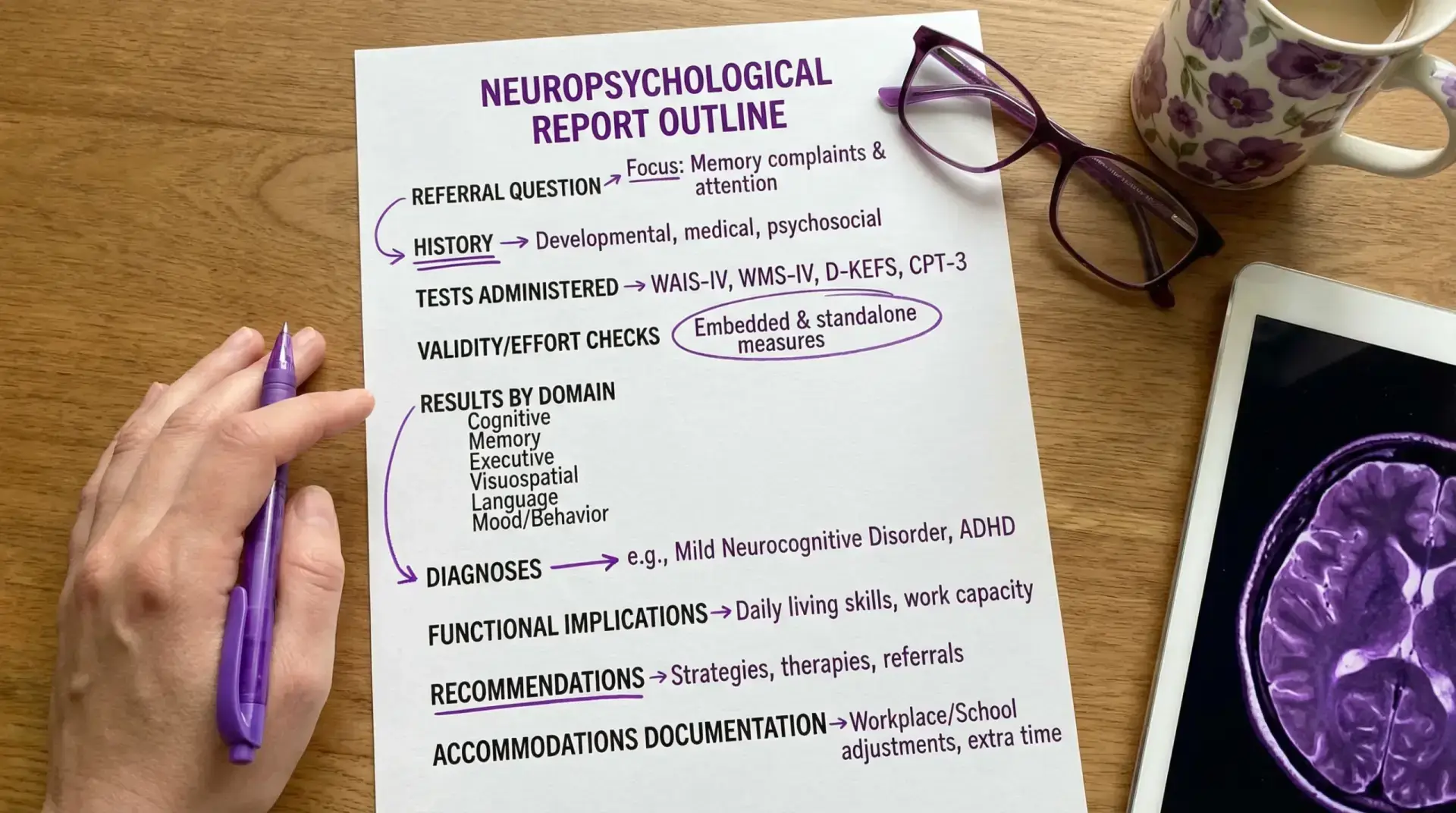
1) Referral question and reason for evaluation
This is the report’s North Star. It frames why the evaluation was done and what decisions it is meant to support.
Examples:
- College student: ADHD vs anxiety, and documentation for accommodations
- Executive: “high functioning” but missing details, late deliverables, burnout, errors
- Adult: cognitive decline concerns vs reversible causes
- Legal/medical: capacity questions (decision-making ability)
A strong report clearly restates the referral question and answers it directly in the impressions and recommendations.
2) Background history (medical, psychiatric, developmental, educational, occupational)
This section is not filler. It helps the evaluator interpret test data in context.
It commonly includes:
- Symptoms timeline (when did this start, what changed)
- Medical and neurologic history (including head injuries)
- Sleep, substance use, medications
- Mood and anxiety symptoms (which can reduce attention and memory efficiency)
- School/work history (grades, standardized tests, performance reviews)
For families and students, this history can overlap with psychoeducational needs. If you are weighing different evaluation types, see: Neuropsychological vs Psychoeducational Testing: What’s the Difference & Which Do You Need?.
3) Tests administered (your “methods” section)
You will usually see a list of:
- Cognitive tests
- Rating scales (self, parent, teacher, partner)
- Sometimes academic measures (especially when accommodations are a goal)
Do not judge the quality of an evaluation by the number of tests alone. Relevance to the referral question and correct interpretation matter more.
4) Behavioral observations and validity indicators
High-quality reports explain how you approached the tasks. This can include:
- Effort and engagement
- Anxiety level during testing
- Speed vs accuracy style
- Impulsivity, checking behaviors, and frustration tolerance
- Built-in measures that help estimate whether results are interpretable
If this section is missing, it can weaken the report’s credibility when accommodations or complex clinical decisions are involved.
5) Neuropsychological Evaluation Report Results by Cognitive Domain
Most reports organize results into domains such as:
- Attention and working memory: holding and manipulating information (common pain point in ADHD)
- Executive function: planning, prioritizing, cognitive flexibility, inhibition, self-monitoring
- Processing speed: efficiency under time pressure (often affected by depression, anxiety, medical illness, or neurologic change)
- Learning and memory: whether the issue is encoding (getting information in) vs retrieval (getting it out)
- Language: word finding, comprehension
- Visuospatial skills: visual reasoning, construction
A report that supports treatment planning will go beyond “average vs below average.” It explains patterns, for example:
- Strong reasoning with weak speed (common in burnout or depression)
- Weak sustained attention with relatively intact learning when focused (common in ADHD)
- Memory complaints driven by anxiety and sleep disruption rather than neurodegenerative change
If cognitive baseline tracking is part of your plan, this is central. See: Worried About Memory Loss? Why Building a Cognitive Baseline Matters (includes work by Dr. Dana Haywood, PhD).
6) Emotional and psychiatric measures
Many neuropsych evaluations include a structured assessment of:
- Depression symptoms
- Anxiety/panic symptoms
- Trauma-related symptoms
- Somatic symptom burden
This matters because mood and anxiety can meaningfully affect concentration, speed, and memory. (If panic is part of your picture, you may also find: Panic Attack Treatments That Actually Help useful.)
7) Diagnostic impressions and differential diagnosis
This is where the neuropsychological evaluation report should answer the referral question in plain language and clinical terms.
A strong differential diagnosis discusses overlapping possibilities, for example:
- ADHD vs anxiety-related inattention
- Depression-related slowed processing vs primary neurocognitive disorder
- Sleep deprivation vs emerging cognitive decline
For ADHD specifically, the National Institute of Mental Health emphasizes that ADHD is a clinical diagnosis, and a careful evaluation is essential because symptoms can overlap with other conditions.
8) Functional implications (the “so what?” section)
This section is what schools, HR departments, and treating clinicians often care about most.
Look for translation into real-world terms:
- What tasks will be hardest (timed exams, multitasking, shifting between meetings, error monitoring)
- What environments worsen symptoms (open office, high-interruption workflows)
- What supports improve performance (structured planning, reduced distractions, extended time)
9) Recommendations (the highest value part of the report)
Recommendations should be specific and individualized. In a clinic that integrates neuropsychological testing and treatment in NYC, recommendations may include:
- Psychotherapy (for example, CBT skills for anxiety, stress, and performance)
- Coaching or skill-based executive function support
- Medication consultation when appropriate
- Sleep evaluation or CBT-I support
- Cognitive Remediation Therapy (CRT) is indicated when targeted cognitive training is indicated
For patients exploring cognitive interventions, see: CBT vs. CRT: Cognitive Behavioral Therapy and Cognitive Remediation Therapy in Midtown NYC, and the practice’s YouTube updates: Cognitive Remediation 3-Part Series Videos.
A Quick Map of Neuropsychological Evaluation Report Sections and How to Use Them
| Report section | What to look for | How to use it next |
|---|---|---|
| Referral question | The exact question(s) being answered | Confirms whether the evaluation matches your goals (accommodations, treatment, baseline, capacity) |
| Validity/behavioral observations | Whether the results are interpretable, and any testing conditions | Protects credibility for schools, employers, and clinicians |
| Domain results | Patterns (speed vs accuracy, attention vs memory encoding) | Guides targeted strategies, CRT, coaching, and medication planning |
| Impressions/differential | “Why this pattern?” and ruling in or out competing explanations | Reduces misdiagnosis, supports coordinated care |
| Functional implications | Real-life translation | Helps you advocate for supports that match your profile |
| Recommendations | Specific steps, not generic tips | Becomes your action plan for treatment and accommodations |
How to use your neuropsych report: playbooks for common NYC use cases
The best way to think about your neuropsychological evaluation report is as a set of instructions for your next 90 days. Below are practical, high-yield ways patients use reports after testing.
College ADHD and accommodations. Documentation that schools actually accept
For college and graduate students, the goal is usually twofold: to clarify diagnosis and obtain documentation for reasonable accommodations.
Common accommodation targets include:
- Extended time for exams
- Reduced-distraction testing
- Note-taking support or assistive technology
- Flexibility around deadlines in documented circumstances
Your neuropsychological evaluation report is strongest when it links:
- Documented history and current symptoms
- Objective findings (test and rating scale patterns)
- Functional impairment (how it affects academic tasks)
- Explicit accommodation rationale (why extended time, why reduced-distraction)
If your needs are primarily academic skill-based (reading, writing, math), psychoeducational testing may be central. See: Could ADHD or a Learning Disability Be Holding You Back? How Psychoeducational Testing Can Help.
If you are seeking a dedicated ADHD-focused evaluation path, also see: Private ADHD Testing in NYC.
Executive function for professionals
Executives and high-responsibility professionals often present with “quiet” impairment: the work is getting done, but at a steep cost (late nights, constant rechecking, missed details, anxiety spikes, burnout).
A neuropsych report can help you:
- Separate executive function vulnerability from generalized stress
- Identify compensations that are failing (for example, over-reliance on working memory)
- Target interventions that preserve performance without escalating hours
In practice, this often leads to a combined plan:
- Skills-based therapy or coaching for planning systems
- Anxiety treatment (CBT, supportive therapy, sometimes medication)
- Sleep stabilization when needed
If burnout is part of the picture, see: Why Burnout Isn’t Just Stress.
Cognitive decline and brain fog (baseline, monitoring, and treatable contributors)
Many adults worry that forgetfulness means dementia, but cognitive symptoms can also come from treatable factors (sleep disruption, mood disorders, medication side effects, hormonal changes, post-viral syndromes).
A neuropsych report helps by:
- Establishing a measurable baseline
- Identifying whether the pattern fits neurodegenerative change vs reversible contributors
- Recommending next steps such as medical workup, targeted therapy, or cognitive remediation
For education on brain fog vs decline, revisit: Brain Fog vs Cognitive Decline. For aging-related cognitive concerns, the National Institute on Aging provides a helpful overview of memory changes and when to seek evaluation.
Capacity evaluations. When decision-making ability is the question
Capacity questions arise in situations such as:
- Medical consent decisions
- Financial decision-making concerns
- Guardianship-related questions
- High-stakes disputes where cognitive status is central
A neuropsychological evaluation may contribute objective evidence about cognition, but “capacity” is a functional and context-specific legal/medical concept. A report should clearly define:
- The specific capacity question is being asked
- The functional standard relevant to that context
- How cognitive findings relate to that functional standard
If capacity is your referral question, ask in advance what documentation is needed and who the report is intended for.
What happens after testing? How to turn findings into treatment?
The feedback session is only the start. The real value comes from a coordinated follow-through plan.
In an integrated model, post-testing steps commonly include:
- Sharing the report (with your permission) with your treating clinician(s)
- Prioritizing recommendations into a realistic sequence
- Scheduling targeted treatment, for example, psychotherapy, skills work, CRT, or medication consultation
If ADHD is part of your recommendations and you want non-medication options alongside (or before) medication, see: Evidence-Based Non-Medication Interventions for ADHD.
Insurance and cost guide. What to ask before you schedule?
In NYC, neuropsychological testing is often pursued by self-pay patients or out-of-network benefits because of limited in-network availability and lengthy waits. Since policies vary widely, it helps to approach insurance and cost planning like a checklist.
Here are the most useful questions to ask any clinic before starting:
- What is included (intake, testing hours, scoring, feedback session, written report, accommodation letter if needed)?
- Is the clinic in-network or out-of-network with my plan?
- If out-of-network, can you provide documentation to help me submit a claim (sometimes called superbill support)?
- What is the expected timeline for the full report?
- If accommodations are needed, will the report explicitly connect findings to requested supports?
The goal is not only cost clarity, but also ensuring the evaluation matches your end use (treatment, school, work, capacity).
| Cost driver | Why it changes cost | What to clarify upfront |
|---|---|---|
| Referral complexity | ADHD accommodations vs cognitive decline vs capacity questions vary in scope | Confirm the referral question and expected testing breadth |
| Time required | More testing time typically means higher fees | Ask what is included and whether add-on testing is possible |
| Documentation needs | Schools and employers may require specific language | Ask whether the report will include explicit accommodation rationale |
| Coordination of care | Integrated care can add value (and time) | Ask how results connect to treatment planning and follow-up |
If you are looking for integrated care that connects testing to treatment, start with the practice’s pillar: Neuropsychological Testing Explained.
Psychiatrist involvement in neuropsych testing: when and why it matters
Neuropsychologists specialize in the measurement and interpretation of cognition and behavior. Psychiatrists specialize in diagnosis, medical evaluation, and medication management, especially when symptoms overlap (ADHD vs anxiety, depression vs cognitive slowing, panic vs medical issues).
In a Multidisciplinary Diagnostic Team, psychiatrist involvement is especially important when:
- Medication options are being considered (for ADHD, anxiety, depression, and sleep)
- There are comorbid mood, trauma, or substance-related factors
- Cognitive symptoms may be influenced by medical issues or medication side effects
- Functioning is high-stakes (executives, safety-sensitive jobs)
It can also prevent a common pitfall: treating the label rather than the person. Two people can both meet criteria for ADHD, but require very different plans depending on anxiety, sleep, medical history, and cognitive profile.
For a broader look at how psychiatrists coordinate with therapy and testing, see: The Role of Psychiatrists in Treating Depression.
If ADHD medication is being considered
A neuropsychological evaluation report may strengthen diagnostic confidence and clarify functional impairment, but medication decisions still require a medical evaluation, risk-benefit discussion, and ongoing monitoring. The FDA provides patient-focused safety information on stimulant medications.
If your neuropsychological evaluation report supports ADHD, it can help a psychiatrist determine::
- Whether symptoms are consistent across settings and time
- Whether executive function vulnerabilities match ADHD patterns
- What comorbid conditions should be addressed first or alongside ADHD
For patients exploring ADHD presentations and diagnostic nuance, see Dr. Dana Haywood’s featured content: ADHD in Women (with video).
Choosing the right neuropsych testing and treatment team in NYC
If you are searching for neuropsychological testing and treatment in NYC, the differentiator is rarely the test battery alone. It is whether the report is built to translate into care.
Practical indicators of a strong fit include:
- The evaluation is anchored to a clear referral question (accommodations, executive performance, cognitive decline, capacity)
- The report includes validity/behavioral observations
- Recommendations are specific, prioritized, and realistically actionable
- There is a pathway to treatment (therapy, medication management, CRT, or coordinated referrals)
For New Yorkers, logistics also matter. If you are looking for in-person testing, a Midtown location can be a meaningful convenience, especially when you are near Bryant Park or convenient to Grand Central for commuting.

Next step: use your report as a treatment plan, not a final answer
If you already have a neuropsychological evaluation report, the fastest way to benefit is to bring it into a coordinated plan that connects findings to action. If you are considering testing, it helps to start with a team that can translate results into care.
- Start with the core guide: Neuropsychological Testing Explained
- Compare evaluation types if school is a focus: Neuropsychological vs Psychoeducational Testing
- If you want to explore integrated services in Midtown Manhattan or via telepsychiatry in New York, visit Comprehensive Psychiatric Services in NYC to request a next-step consultation.