
Neuropsychological Testing in NYC: Clear Answers for Focus, Memory, and Cognitive Clarity
You’re still performing. You’re still showing up. But focus takes more effort, words come more slowly, or the mental stamina that once carried you through long days feels less reliable than it used to.
For high-achieving professionals in New York, these changes are easy to rationalize: stress, lack of sleep, burnout, hormonal changes, or “just getting older.” But when symptoms persist or begin affecting work, confidence, relationships, school, or daily functioning, it may be time to understand what is actually happening.
Neuropsychological testing at Dr. Iospa Psychiatry Consulting in Midtown Manhattan provides a comprehensive, evidence-based assessment of memory, attention, executive functioning, processing speed, and other cognitive abilities. Experienced licensed neuropsychologists conduct testing designed to identify patterns that may not be apparent from symptoms or questionnaires alone.
For some patients, testing confirms a suspected diagnosis. For others, it reveals that symptoms attributed to ADHD, anxiety, depression, aging, or burnout may have another explanation. And sometimes, ruling out a cognitive disorder is just as clinically valuable as identifying one.
If you are experiencing persistent changes in memory, attention, organization, processing speed, or other cognitive abilities, a neuropsychological evaluation can help clarify what may be contributing to those difficulties and guide appropriate next steps.
TL;DR: Neuropsychological Testing at a Glance
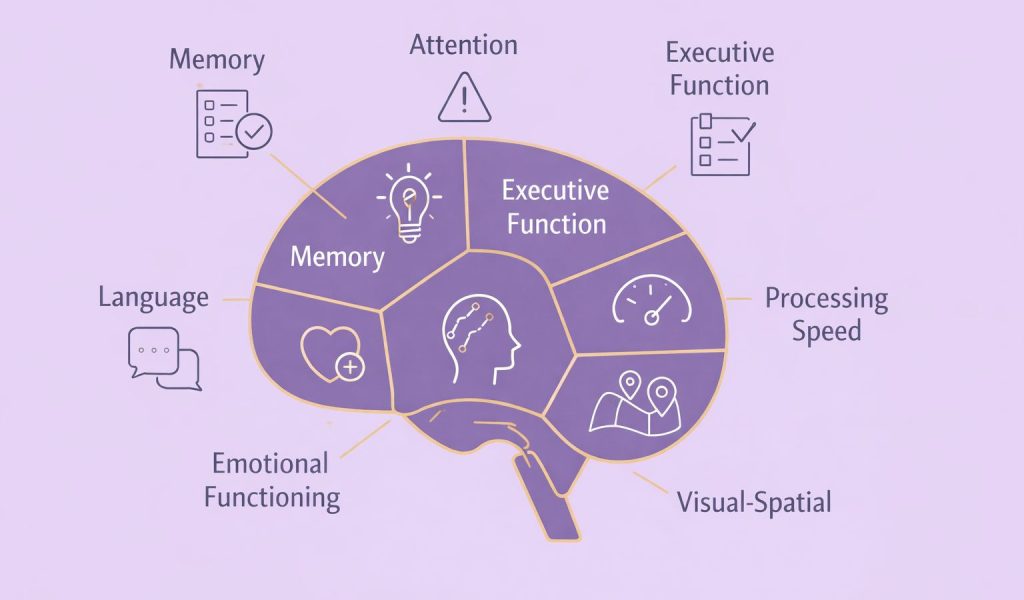
What it evaluates: Memory, attention, executive functioning, processing speed, language, learning, visual-spatial skills, and emotional functioning.
Who may benefit: Adults, professionals, older adults, children, adolescents, and college students with unexplained cognitive, attention, memory, learning, or executive-function concerns.
What it can help clarify: ADHD, memory problems, cognitive changes, brain fog, learning disorders, concussion-related difficulties, and the cognitive effects of psychiatric, neurological, sleep, hormonal, or other medical conditions.
What you receive: A detailed interpretation of your cognitive strengths and weaknesses, diagnostic impressions when appropriate, a written report, and individualized recommendations.
Where: In-person neuropsychological evaluations are available at our Midtown Manhattan office.
What happens afterward: When appropriate, results can be integrated with psychiatric treatment, psychotherapy, or Cognitive Remediation Therapy within the same practice.
What Is Neuropsychological Testing?
Neuropsychological testing is a structured, multi-domain cognitive evaluation that goes far beyond a clinical interview or online screening tool.
Using validated, standardized measures, a neuropsychologist evaluates how different cognitive systems are functioning. Depending on the reason for referral, this may include memory, attention, executive functioning, language, processing speed, visual-spatial abilities, learning, and emotional functioning.
The purpose is not simply to produce a collection of test scores. Your neuropsychologist interprets the pattern of strengths and weaknesses in the context of your history, symptoms, education, occupation, medical conditions, medications, sleep, and emotional functioning.
This integrated approach can help distinguish between conditions that may produce similar symptoms.
Once testing is complete, you receive a written report explaining the findings, diagnostic impressions when appropriate, and individualized recommendations. Learn more about what a neuropsychological evaluation report includes and how to use it.
There is nothing to study beforehand, and there is no passing or failing. The evaluation is designed to understand how you naturally process different types of information.
Who Should Consider Neuropsychological Testing in NYC?
People seek neuropsychological evaluations for very different reasons. Some have noticed a recent change. Others have struggled with attention, organization, learning, or memory for years without a clear explanation.
Professionals and Executives
Attorneys, physicians, finance professionals, executives, entrepreneurs, academics, and other high-performing adults may compensate for subtle cognitive difficulties for years.
A problem can become more noticeable when professional responsibilities increase, sleep deteriorates, hormonal changes occur, stress becomes chronic, or the strategies that once compensated for a weakness stop working as effectively.
Common reasons professionals seek an evaluation include:
Difficulty concentrating or staying organized under pressure
Forgetting conversations, appointments, or details
Needing significantly more time to complete familiar work
Difficulty multitasking or switching between tasks
Word-finding problems
Declining mental stamina
Suspected adult ADHD
Persistent brain fog
Cognitive changes during perimenopause
Cognitive difficulties following concussion or traumatic brain injury
If you are trying to distinguish ADHD from anxiety, a comprehensive evaluation can help determine whether objective cognitive findings support the clinical picture.
For professional women, ADHD often presents differently than the classic description. Similarly, symptoms that feel like anxiety may sometimes be associated with executive dysfunction.
Diagnostic clarification matters because treatment depends on what is actually driving the symptoms. In some cases, persistent cognitive complaints may also help explain why depression treatment has not produced the expected improvement.
For patients in midlife who are unsure whether symptoms are related to mood, sleep, hormonal changes, or cognition, see when mood and sleep begin to change in midlife.
Adults With Memory or Cognitive Aging Concerns
Occasional forgetfulness is common. A persistent change from your previous level of functioning deserves more careful attention.
Neuropsychological testing can help establish whether memory concerns reflect normal variability, attention problems, mood symptoms, sleep disruption, medication effects, medical factors, or a pattern that warrants further neurological or medical evaluation.
Brain fog and early cognitive decline can look similar in everyday life while having very different causes.
Testing can also create an objective baseline. Building a cognitive baseline allows future changes to be compared with documented performance rather than relying solely on memory or subjective impressions.
Sleep should not be overlooked either. Poor sleep can significantly affect attention, processing speed, memory, and executive functioning. See Can Sleep Heal More Than We Think? for more information.
Children, Adolescents, and College Students
Parents and young adults may seek testing when academic struggles, attention difficulties, learning problems, or behavioral changes have not been adequately explained.
An evaluation may help clarify ADHD, learning disorders, developmental concerns, executive-function difficulties, and emotional factors that interfere with academic performance.
For primarily school-based learning concerns, our psychoeducational evaluation service may be the appropriate starting point.
You can also learn more about the difference between neuropsychological vs. psychoeducational testing.
What Conditions and Concerns Can Neuropsychological Testing Help Clarify?
Neuropsychological testing is not used to diagnose every condition by itself. Instead, it provides objective cognitive data that can be combined with clinical history, medical information, behavioral observations, and other appropriate evaluations.
Depending on the individual, testing may be useful when evaluating:
| Concern | What Testing May Help Clarify |
|---|---|
| ADHD | Attention, working memory, processing speed, executive functioning, and alternative explanations for attention problems |
| Memory problems | Whether reported forgetfulness corresponds to measurable memory impairment and what type of memory process is affected |
| Brain fog | Whether difficulties involve attention, processing speed, memory, executive functioning, or another cognitive domain |
| Concussion/TBI | Cognitive strengths and weaknesses following an injury |
| Learning difficulties | Patterns involving reading, writing, mathematics, memory, attention, or information processing |
| Cognitive aging | Current cognitive functioning and whether additional medical or neurological assessment may be appropriate |
| Anxiety or depression with cognitive symptoms | How emotional symptoms may be interacting with attention, memory, processing speed, and executive functioning |
| Complex diagnostic questions | Whether the overall cognitive pattern supports or challenges the initial clinical hypothesis |
Testing can also be useful when several explanations are possible at the same time. For example, ADHD plus anxiety, menopause-related sleep disruption plus depression, or a history of concussion combined with chronic stress.
What Does Neuropsychological Testing Evaluate?
A comprehensive evaluation may examine several cognitive domains. The exact test battery is individualized according to the referral question.
Memory and Learning
Testing examines how efficiently new information is learned, stored, and retrieved. Importantly, not all “memory problems” originate in memory itself. Poor attention during initial learning, for example, can later feel like forgetting.
Attention and Concentration
These measures assess sustained attention, distractibility, working attention, and the ability to remain focused over time.
Executive Functioning
Executive functions help us plan, prioritize, organize, solve problems, regulate behavior, shift strategies, and complete multi-step tasks.
Someone can have strong intelligence and professional accomplishments while still having meaningful executive-function weaknesses.
Processing Speed
Processing speed reflects how efficiently someone can take in, work with, and respond to information.
Reduced processing efficiency may occur for many reasons and must always be interpreted in the context of the complete evaluation.
Language and Communication
Testing may examine verbal comprehension, naming, verbal fluency, and word retrieval.
Visual-Spatial Abilities
These abilities involve understanding spatial relationships, interpreting visual information, and solving problems that do not rely primarily on language.
Emotional and Psychological Functioning
Anxiety, depression, chronic stress, trauma, and other emotional factors can affect cognitive performance. Appropriate psychological measures can help the neuropsychologist understand how these factors interact with the cognitive findings.
What to Expect During a Neuropsychological Evaluation
A neuropsychological evaluation is more comprehensive than taking a single test. It is a clinical process designed around the question that brought you to testing.
1. Clinical Interview
The evaluation usually begins with a detailed interview covering current concerns, medical and psychiatric history, medications, education, occupation, sleep, and relevant developmental or family history.
When appropriate and with permission, previous records may also be reviewed.
2. Neuropsychological Testing
You will complete a series of standardized tasks selected for your individual evaluation.
Some involve remembering information. Others assess concentration, problem-solving, language, processing speed, or visual reasoning.
Most evaluations take several hours, depending on the referral question and complexity of the case. Breaks can be incorporated when needed.
3. Scoring and Interpretation
The neuropsychologist does much more than determine whether an individual score is “high” or “low.”
Performance is analyzed across tests and cognitive domains and interpreted in the context of your background, history, symptoms, and day-to-day functioning.
The pattern is often more informative than any individual test result.
4. Written Neuropsychological Report
Your report brings the findings together into a clinically meaningful picture.
Depending on the purpose of the evaluation, it may include:
Cognitive strengths and weaknesses
Interpretation of significant findings
Diagnostic impressions when appropriate
Treatment recommendations
Strategies for work, school, or everyday functioning
Recommendations for additional medical or specialist evaluation when indicated
Read more about what neuropsychological reports include.
5. Feedback and Next Steps
Results are reviewed with you so that you understand not only what the testing found, but what to do with that information.
That distinction is important. A neuropsychological report should not simply sit in a file. Its value comes from translating the findings into practical next steps.
How Neuropsychological Testing Can Change Treatment
A clear cognitive profile can significantly change the direction of care.
For example, someone who reports poor concentration, low motivation, forgetfulness, and mental fatigue may initially assume the problem is depression. Another person may be convinced that the symptoms are ADHD.
Testing may reveal a more complex picture.
The results can help clinicians determine which difficulties are most prominent and which interventions are most appropriate.
Depending on the findings, recommendations may include psychiatric treatment, psychotherapy, medical evaluation, workplace or academic strategies, sleep interventions, or Cognitive Remediation Therapy (CRT).
When attention, working memory, processing speed, or executive skills are active treatment targets, CRT may be incorporated into a broader treatment plan. You can also explore the differences between CBT and CRT.
What Happens After Neuropsychological Testing?
Receiving a diagnosis is not the endpoint.
The next question is: What should we do differently now that we have this information?
At Dr. Iospa Psychiatry Consulting, neuropsychological testing is available within a multidisciplinary practice that also provides psychiatric treatment, psychotherapy, and cognitive remediation.
When appropriate and with your authorization, findings can therefore be incorporated into your ongoing care rather than remaining disconnected from treatment.
Recommendations may include:
Medication evaluation or adjustment
Psychotherapy
Cognitive Remediation Therapy
Behavioral and organizational strategies
Workplace or academic recommendations
Sleep interventions
Additional medical, neurological, or other specialist evaluation
For a detailed roadmap, see What Happens After Neuropsychological Testing.
Why Choose Our NYC Neuropsychology Practice?
Neuropsychological testing is only as useful as the clinical interpretation that follows it.
Our approach combines comprehensive cognitive assessment with access to a multidisciplinary mental-health team. This is particularly valuable when cognitive symptoms overlap with psychiatric symptoms, sleep problems, hormonal changes, medications, or other health concerns.
Patients choose our practice for:
Experienced licensed neuropsychologists
Comprehensive, individualized evaluations
A Midtown Manhattan location
Experience evaluating complex adult cognitive and psychiatric presentations
Evaluation services for children, adolescents, college students, adults, and older adults
Coordination with psychiatrists and psychotherapists when appropriate
Access to Cognitive Remediation Therapy when cognitive rehabilitation is recommended
Clear written findings and practical recommendations
Meet Our Neuropsychologists
Our neuropsychology team includes:
Yuka Cohen, PsyD, ABPP-CN — Board Certified in Clinical Neuropsychology
Dana Haywood, PhD — Licensed Clinical Psychologist and Neuropsychologist
Mark Johnson, PhD— Licensed Clinical Psychologist and Neuropsychologist
Catherine Stolove, PhD ABPP-CN — Licensed Clinical Psychologist and Neuropsychologist
William Lu, PsyD — Licensed Clinical Rehabilitation Psychologist and Neuropsychologist
You can review the full clinical team on our Our Doctors page.
Preparing for Your Neuropsychological Evaluation
There is no need to study for neuropsychological testing.
Unless your clinician gives you different instructions, the goal is to arrive rested and able to perform as you normally would.
Before your appointment, you may be asked to provide relevant records such as previous evaluations, school records, medical records, medication information, or other documentation related to the referral question.
Bring glasses, hearing aids, or other devices you normally rely on.
Most importantly, don’t worry about trying to perform perfectly. There is no passing or failing. The goal is to obtain an accurate picture of your current functioning.
Review our Prepare for Your Visit page for practical information.
Neuropsychological Testing, Insurance, and Reimbursement
Coverage for neuropsychological testing depends on the reason for testing, your insurance plan, medical necessity, and the specific services provided.
Our clinicians participate with Original Medicare where applicable. For commercial insurance, the practice generally works on an out-of-network basis. Patients with out-of-network benefits may be eligible for reimbursement after applicable deductibles and according to their individual plan.
Our office can provide appropriate documentation for insurance submission.
Because coverage varies considerably, patients should verify their individual neuropsychological-testing benefits before beginning an evaluation.
Frequently Asked Questions About Neuropsychological Testing
Does neuropsychological testing feel like an exam?
There are structured tasks, but there is no passing or failing. The goal is not to judge your intelligence or knowledge. Testing measures how different cognitive abilities function under standardized conditions. More on the topic: Neuropsychological Testing Explained: What It Is, Who It Helps, and What to Expect.
How long does neuropsychological testing take?
The length varies according to the reason for referral and the complexity of the evaluation. Comprehensive testing commonly requires several hours, and breaks can be provided.
Can neuropsychological testing diagnose ADHD?
Neuropsychological testing can provide valuable objective information about attention, working memory, processing speed, and executive functioning. ADHD diagnosis, however, also requires clinical history, symptoms, functional impairment, and consideration of alternative explanations. Testing is one component of a comprehensive diagnostic evaluation when indicated.
Can neuropsychological testing detect dementia?
Testing can identify patterns of cognitive strengths and weaknesses and determine whether measurable cognitive impairment is present. Results may help distinguish normal aging from patterns that warrant further medical or neurological investigation. Neuropsychological testing should be interpreted together with medical history and other appropriate evaluations.
What is the difference between neuropsychological and psychoeducational testing?
Neuropsychological testing generally evaluates a broader range of cognitive functions and may address neurological, psychiatric, developmental, or medical questions. Psychoeducational testing focuses more specifically on learning, academic achievement, and educational needs.
Read our detailed comparison of neuropsychological vs. psychoeducational testing.
Can an online cognitive test replace a neuropsychological evaluation?
No. Online screening tools may identify symptoms or suggest that further evaluation is appropriate, but they do not provide the comprehensive history, standardized assessment, behavioral observations, interpretation, and differential diagnosis of a professional neuropsychological evaluation.
What if my test results are normal?
Normal findings can be clinically useful.
If testing does not show significant cognitive impairment, clinicians can focus more closely on other possible contributors such as anxiety, depression, chronic stress, sleep disruption, medication effects, hormonal changes, or medical conditions.
It can also establish a baseline against which future changes can be compared.
Are my results confidential?
Yes. Neuropsychological evaluations are confidential medical records and are handled according to applicable privacy requirements. Information is released to outside parties only as permitted by law or with appropriate authorization.
Do you accept insurance for neuropsychological testing?
Our clinicians participate with Original Medicare where applicable. For commercial insurance, we generally work out-of-network. Patients with out-of-network benefits may receive reimbursement depending on their individual plan, deductible, and coverage.
Do I need a referral?
Referral requirements vary depending on the purpose of testing and insurance requirements. You can contact our office to discuss the reason you are considering an evaluation and determine the appropriate next step.