

Medically reviewed by: Alla Iospa, MD, Psychiatrist
Many adults who book an evaluation say the same thing: “I can’t tell if I’m anxious, if I have ADHD, or if I’m just burned out.” In a fast-paced environment like NYC, the line can feel especially blurry. ADHD and anxiety often share surface symptoms (distractibility, restlessness, procrastination, sleep trouble), but the underlying drivers are different, and that difference shapes what actually helps. Many adults wonder whether difficulty focusing, procrastination, or feeling overwhelmed comes from ADHD vs anxiety in adults. While the symptoms often overlap, the reasons behind them are different.
Below is a clinician-style, quick (but thorough) guide to separating ADHD vs anxiety in adults, including what tends to be missed, what to track before an appointment, and when neuropsychological testing can clarify the picture.
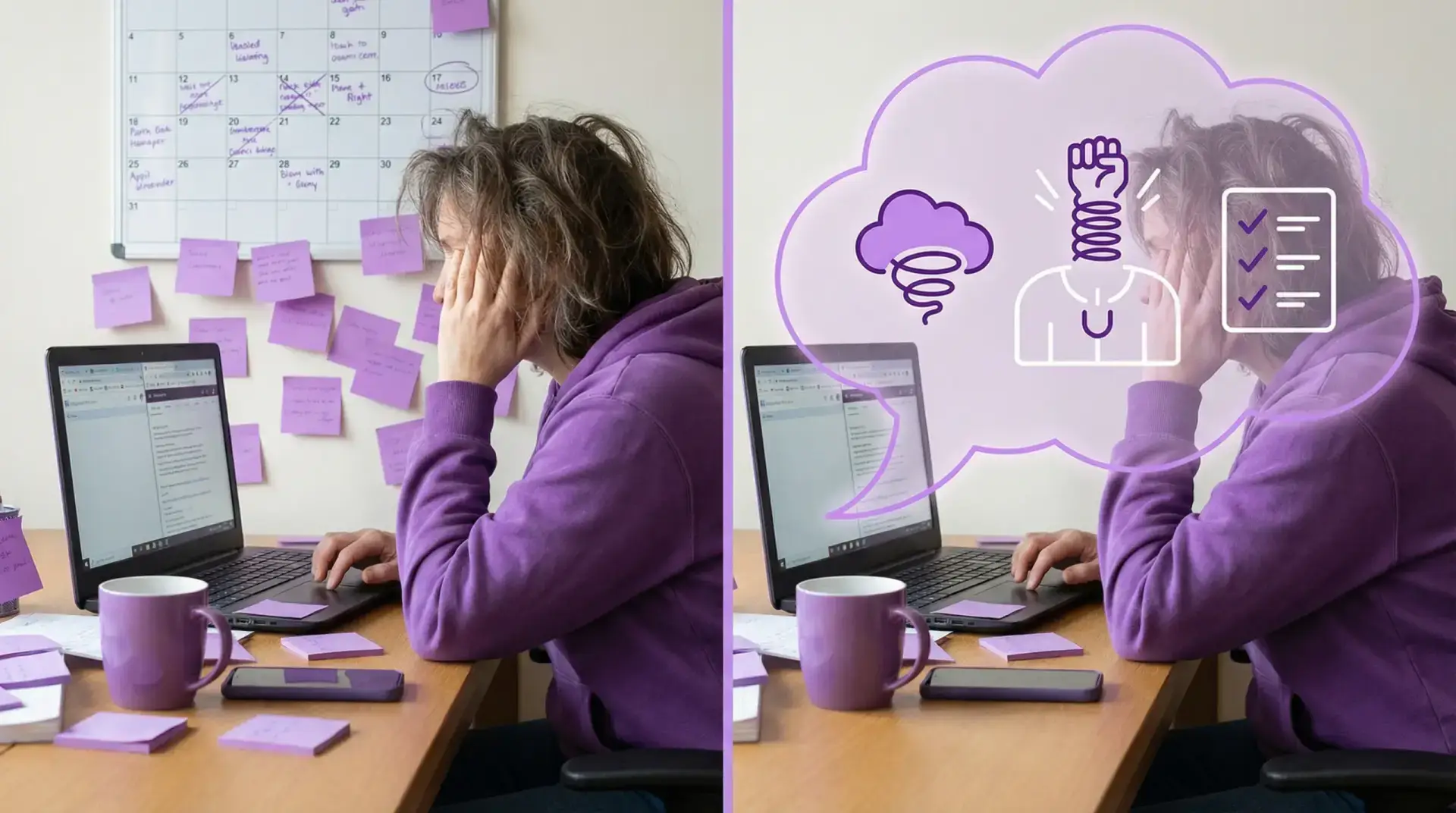
ADHD vs anxiety in adults: the simplest clinical distinction
A practical way to start is to ask:
- ADHD: Is my attention pulled away by novelty, distraction, or difficulty sustaining effort, even when I am not worried?
- Anxiety: Is my attention pulled away by threat scanning, worry loops, or fear of consequences, even when I want to focus?
Both can be true at the same time. In fact, comorbidity is common in clinical practice, and anxiety can develop secondarily when years of ADHD-related friction (missed deadlines, chronic overwhelm, social mistakes) create a constant sense of urgency.
For diagnostic reference, the National Institute of Mental Health outlines core symptom patterns for ADHD and anxiety disorders, including how symptoms must affect functioning.
Quick comparison table (what it looks like day to day)
| What you notice | More typical of adult ADHD | More typical of anxiety | When it’s often both |
|---|---|---|---|
| “I can’t focus” | Focus varies by interest, novelty, urgency; may hyperfocus on preferred tasks | Focus hijacked by “what if” thinking, catastrophizing, or performance fears | ADHD creates errors and anxiety amplifies monitoring and self-criticism |
| Procrastination | Task initiation difficulty, low activation, time blindness | Avoidance of uncertainty, fear of failure, perfectionism | ADHD delays raise stakes, then anxiety spikes |
| Restlessness | Internal motor, fidgeting, impatience, needing stimulation | Feeling keyed up, tense, on edge | High arousal plus poor self-regulation |
| Forgetfulness | Losing items, missed steps, missed appointments, inconsistent routines | Memory feels worse because attention is preoccupied by worry | Sleep loss and stress worsen both |
| Emotional patterns | Frustration, quick overwhelm, rejection sensitivity | Persistent worry, panic sensations, dread | Irritability, shutdown, or “overfunctioning” |
| Timeline clues | Often lifelong traits (even if unrecognized), with impairment across settings | May begin after stressors, health events, or transitions | ADHD vulnerability plus new stressor triggers anxiety |
Clinician “tells” that point more toward ADHD
These are not diagnostic by themselves, but they are patterns clinicians weigh heavily:
1) The problem is consistency, not capability
Adults with ADHD often report they can perform extremely well under certain conditions (deadline pressure, novelty, high interest), but cannot reliably reproduce it. Anxiety can also create inconsistency, but usually through fear and avoidance rather than an “on/off” attention system.
2) Time blindness and task initiation are front and center
If you repeatedly underestimate how long things take, struggle to start even simple tasks, or get stuck in “I know what to do, I just can’t begin,” ADHD moves up the list.
3) A childhood footprint exists, even if subtle
Adult ADHD typically has roots earlier in life, even if it was masked by intelligence, structure, or high external support. Many women and high-achieving adults were never identified because symptoms were more inattentive and internal. Our practice discusses this pattern in ADHD in women, featuring insights from Dr. Dana Haywood.
4) Your mind wanders even when you feel calm
Anxiety-based inattention often tracks with worry. ADHD-based inattention can show up on a “good” day, during a pleasant conversation, or while reading something you actually want to absorb.
Clinician “tells” that point more toward anxiety
1) The attention problem is threat-driven
Anxiety pulls attention toward perceived danger: health fears, relationship fears, performance fears, and financial fears. The mind rehearses outcomes to gain control.
2) Physical arousal symptoms are prominent
Many adults with anxiety describe chest tightness, GI upset, muscle tension, shortness of breath, or panic episodes. If panic is part of the picture, see our clinical overview of anxiety and panic attacks and panic attack treatments.
3) Perfectionism is driving avoidance
A classic anxiety loop is: fear of doing it imperfectly, avoid starting, then shame increases, then worry increases. That can resemble ADHD procrastination, but the emotional engine is different.
4) Symptoms track with stressors
If symptoms started after a specific period (job change, medical illness, postpartum, bereavement, a traumatic event) and you previously had solid organization and follow-through, anxiety may be primary.
Why misdiagnosis is common (and how to reduce it)
ADHD and anxiety can mimic each other in three main ways:
Anxiety can cause “executive dysfunction.”
When the brain is scanning for threat, working memory and concentration drop. Sleep disruption worsens this further. If sleep is a major variable, our post Can sleep heal more than we think? explains why evidence-based sleep treatment (like CBT-I) can improve mood and anxiety symptoms.
ADHD can create secondary anxiety
Years of missed deadlines, forgotten tasks, or interpersonal friction can lead to chronic hypervigilance: “If I don’t worry constantly, I’ll drop the ball.” In that scenario, treating ADHD often reduces anxiety indirectly.
Both can coexist and amplify each other
This is common in high-pressure roles (finance, law, healthcare, tech). Executives may “compensate” with intense effort and high anxiety, then burn out. If you are also feeling depleted, our NYC-focused guide Why burnout isn’t just stress is a helpful adjunct.
What to track before an appointment (fast, high-yield)
If you are seeking adult ADHD treatment in NYC (or via telepsychiatry in New York), tracking the right details can make your evaluation more efficient.
Write down, for 1 to 2 weeks:
- When focus is best (time of day, location, urgency, interest)
- When focus is worst (emails, meetings, reading, forms, unstructured time)
- Your sleep window, caffeine, alcohol, and cannabis use (if any)
- Any panic symptoms (what happens in your body, how long it lasts)
- Real examples of impairment (missed bills, relationship conflict, work errors, academic impact)
When neuropsychological testing helps (and when it may be unnecessary)
A good psychiatric evaluation can often clarify ADHD vs anxiety. But neuropsychological testing becomes especially useful when:
- You have overlapping symptoms (ADHD, anxiety, depression, sleep problems) and need diagnostic clarity
- You are seeking formal documentation for work or school accommodations
- You are worried about cognitive decline or want a baseline
- There is a history of concussion, brain injury, or neurologic complexity
Our practice explains the process and what to expect in Neuropsychological testing explained and What is a neuropsychological evaluation?.
If academic accommodations are part of your goal (common for college students), you may also benefit from understanding neuropsychological vs psychoeducational testing and our Midtown Manhattan resource on psychoeducational testing for ADHD.
For patients focused specifically on ADHD evaluation, see private ADHD testing in NYC.
Treatment implications (why the distinction matters)
If ADHD is primary
A comprehensive plan often includes skills-based supports, plus, when appropriate, medication management.
Medication decisions should be individualized and carefully monitored. The FDA has emphasized safe prescribing practices and updated warnings related to misuse and dependence risks for prescription stimulants in a Drug Safety Communication. This is one reason a thorough diagnostic assessment, medical review, and follow-up plan matter.
Non-medication approaches can also be meaningful, especially for executive function and emotional regulation. Our overview of evidence-based non-medication interventions for ADHD includes Cognitive Remediation Therapy (CRT), mindfulness, and structured strategies.
If anxiety is primary
First-line treatment often includes psychotherapy (commonly CBT-based approaches) and, when indicated, medication. If panic is present, targeted CBT techniques like interoceptive exposure can be particularly effective, as described in our panic resources linked above.
If both are present
Integrated care works best: treat the anxiety that is impairing sleep and physiologic arousal, while also addressing ADHD drivers like time blindness and task initiation.
A helpful framework is understanding when CBT vs CRT fits your needs. See CBT vs. CRT in Midtown NYC, and for a deeper dive into CRT, explore our Cognitive Remediation Therapy video series featuring Dr. Dana Haywood (with links to our YouTube channel).
Local NYC considerations clinicians see often
In Midtown Manhattan and across NYC, adults commonly present with “high functioning” distress:
- Long work hours and constant notifications mask attention issues
- Heavy reliance on caffeine, late-night catch-up work, and weekend “recovery.”
- High achievement plus chronic guilt, which can look like anxiety even when ADHD is the underlying driver
Telehealth can help reduce barriers for those with busy schedules. If you are looking for telepsychiatry in New York, our practice offers both in-person and online care through Comprehensive Psychiatric Services in NYC.
When to seek help urgently
Most ADHD and anxiety evaluations are outpatient, but seek urgent help if you have:
- Suicidal thoughts, intent, or self-harm urges
- Severe panic symptoms you cannot manage or symptoms that could be medical in nature (chest pain, fainting, new neurologic symptoms)
- Substance use that is escalating alongside mood or behavior changes
(If this applies, contact emergency services or go to the nearest emergency department.)
A practical next step if you want clarity
If you are stuck between “Is this ADHD or anxiety?” the next best step is usually a structured clinical evaluation, and when needed, targeted testing to document cognitive patterns and guide treatment.
Our team provides coordinated psychiatric care, psychotherapy, and testing in Midtown Manhattan and via telehealth. If you are exploring diagnostic clarification or adult ADHD treatment in NYC, you can start by reviewing our evaluation resources on private ADHD testing and neuropsychological evaluation.