
Medically Reviewed by: Dr Konstantin Nikiforov MD, Assistant Professor of Psychiatry at the Icahn School of Medicine
High-Functioning Anxiety Is Not an Official Diagnosis. What Is High-Functioning Anxiety?
Although the term high-functioning anxiety is widely used by mental health professionals and patients, it is not an official diagnosis recognized in the Diagnostic and Statistical Manual of Mental Disorders (DSM-5-TR). Instead, it describes a pattern in which a person experiences significant anxiety while continuing to function at a high level in work, school, or other areas of daily life.
From the outside, everything may appear under control. Responsibilities are met, deadlines are achieved, and relationships seem intact. Internally, however, the individual may live with persistent worry, self-doubt, physical tension, and a constant pressure to perform.
A helpful analogy is a business that appears successful to customers while the staff behind the scenes are working frantically just to keep operations running. In much the same way, people with high-functioning anxiety often maintain an image of competence while expending enormous mental and emotional energy simply to keep up.
Because outward functioning remains relatively intact, this pattern frequently goes unrecognized—not only by others, but sometimes by the individual experiencing it. As a result, many people live with chronic anxiety for years before seeking professional evaluation or treatment.
TL;DR
- High-functioning anxiety can be easy to miss. You may appear successful, organized, and confident while privately dealing with persistent worry, overthinking, physical tension, poor sleep, or fear of making mistakes.
- “High-functioning anxiety” is not an official psychiatric diagnosis. It describes a common pattern in which significant anxiety exists despite relatively intact performance at work, school, or in relationships.
- Perfectionism can be a way of managing anxiety. Over-preparing, checking, controlling, procrastinating, or avoiding mistakes may temporarily reduce fear—but can reinforce the anxiety-perfectionism cycle over time.
- High standards and perfectionism are not the same. Healthy ambition allows room for mistakes, rest, and flexibility. Anxiety-driven perfectionism often ties performance to self-worth and makes “good enough” feel unsafe.
- Being productive does not mean anxiety is harmless. Over time, high-functioning anxiety can contribute to insomnia, chronic stress, exhaustion, relationship difficulties, depression, or burnout.
- Anxiety can overlap with other problems. ADHD, executive-function difficulties, depression, burnout, panic symptoms, and sleep problems can look similar or occur alongside anxiety, making an accurate evaluation important.
- Treatment does not mean giving up your ambition. Therapy, medication when appropriate, or combined treatment can reduce fear-driven patterns while helping you stay motivated and successful.
- You do not need to wait until you stop functioning. If maintaining your performance requires constant worry, overwork, avoidance, or emotional exhaustion, it may be worth seeking professional help
Common Signs of High-Functioning Anxiety
Common experiences reported by individuals with high-functioning anxiety include:
- Persistent worry that continues even when life is going well
- Replaying conversations, emails, or decisions and wondering whether something was said or done incorrectly
- Spending excessive time preparing for meetings, presentations, or social situations
- Difficulty relaxing during unstructured free time
- Feeling constantly “on edge” despite the absence of an obvious threat
- Racing thoughts that make it difficult to fall asleep or stay asleep
- Frequently seeking reassurance internally while hesitating to ask others for it
- Avoiding new activities for fear of not performing well immediately
- Procrastinating because of perfectionism or fear of making mistakes
- Feeling guilty when resting or taking time off
- Appearing calm, organized, and successful while feeling overwhelmed internally
How High-Functioning Anxiety Relates to Anxiety Disorders
Many of these experiences overlap with symptoms commonly seen in anxiety disorders. Although high-functioning anxiety is not a formal diagnosis, the symptoms often resemble those seen in conditions such as generalized anxiety disorder (GAD). According to the National Institute of Mental Health (NIMH), anxiety disorders are characterized by excessive fear or worry and may include restlessness, difficulty relaxing, fatigue, impaired concentration, irritability, muscle tension, and sleep disturbance.
For individuals with high-functioning anxiety, these symptoms may simply be less visible. Rather than interfering with outward productivity, they are often masked by overachievement, perfectionism, meticulous planning, and a relentless drive to avoid mistakes. The absence of obvious impairment does not make the anxiety any less real or any less deserving of professional attention.
Perfectionism vs. high standards
To be clear, perfectionism is not the same thing as having high standards. High standards are healthy. They push you to grow, and they let you take real pride in your work. Perfectionism is a different animal. It shows up when your sense of self-worth becomes tied to flawless performance, to constant approval, or to never letting anyone see a weak spot.
Here is the connection I want you to sit with: for a lot of people, perfectionism is not a character trait sitting next to anxiety. It is anxiety’s coping strategy. If the fear underneath is something like “something bad will happen if I am not careful enough” or “I will be judged if I fall short,” then perfectionism becomes the tool anxiety reaches for to manage that fear. It is an attempt to control the outcome, control the risk of criticism, control the sense that failure is always one step away.
How the loop works
I hear versions of these thoughts all the time:
“If I make a mistake, people will lose respect for me.”
“If I do not prepare for every possible outcome, something bad will happen.”
“If I slow down, I will fall behind.”
“If someone is disappointed in me, I have failed.”
“If I cannot do this perfectly, I should not start.”
This is what sets up the loop, and it is worth naming out loud because once you see it, you cannot unsee it. Anxiety sounds the alarm. Perfectionism says the only way to be safe is to control everything. Controlling everything brings the anxiety down, at least for a moment, which teaches your brain to reach for that same strategy again next time. It is a bit like scratching an itch. It feels like relief in the moment, but it trains you to keep scratching, and the itch never actually goes away.
Over time, the very strategy that helped you succeed early on becomes what wears you down.
I want to be clear about what this is not. It is not laziness. It is not weakness. It is not a discipline problem. It is a nervous system stuck in performance mode, like an engine idling at high revs even when the car is parked.
Recognizing high-functioning anxiety and perfectionism in daily life
High-functioning anxiety and perfectionism have a way of reinforcing each other, almost like a thermostat that is set too high and never quite lets the room cool down. Here are four patterns that tend to keep the cycle going.
Achievement as reassurance
Success brings a moment of quiet. You finish the presentation, you get the good feedback, you hit submit. But if the belief underneath is “I am only okay when I perform perfectly,” that relief has a short shelf life. It is like drinking salt water when you are thirsty. It feels like it should help. But it never actually satisfies. So the next deadline shows up as another test of whether you are safe or acceptable.
All-or-nothing standards
Anything less than excellent starts to register as failure. A small typo in an email can feel like proof you are not good enough. A coworker’s neutral, three-word Slack reply can feel like rejection. The bar keeps moving out of reach, even when your actual performance is strong by any reasonable measure.
Fear of evaluation
Much of the drive isn’t really about the work itself. It is about dodging a feared judgment. The question quietly shifts from “did I do this well” to “what will this say about me.”
Trouble starting or finishing
This is the one that surprises people. Perfectionism does not only look like overworking. It can also look like procrastination. If the bar feels unreachable, it can feel safer never to start. If the work never feels quite finished, it can feel impossible to actually call it done.
This is exactly why high-functioning anxiety is so exhausting to live with. You might know, intellectually, that the report does not need to be perfect. But emotionally, “good enough” can feel like walking a tightrope without a net.
Why this so often slides under the radar
Most people I see with this pattern do not come in for help until it starts spilling into sleep, relationships, concentration, physical health, or their ability to actually enjoy what they have accomplished.
Part of the reason is that the world tends to applaud the very behaviors anxiety produces. You get complimented for being the detail-oriented one, the responsive one, the person who is always on. It makes sense, then, if some part of you worries that if the anxiety eases up, your edge goes with it, like taking the pressure off a spring and wondering if it will still bounce back.
In my practice, the goal is never to talk you out of your ambition. I am not trying to make you less driven. The goal is to help you recognize high-functioning anxiety for what it is: a fear response, so the same drive that built your career can finally work for you instead of against you.
In clinical practice, the goal is not to remove your ambition. The goal is to help you function from steadiness, not fear.
| High standards | Anxiety-driven perfectionism |
|---|---|
| Motivated by values, growth, or excellence | Motivated by fear, shame, or threat |
| Allows mistakes as part of learning | Treats mistakes as evidence of failure |
| Rest is part of performance | Rest feels irresponsible or unsafe |
| Feedback can be useful | Feedback feels personally dangerous |
| Work can be completed when it is good enough | Work feels hard to finish unless it feels flawless |
This distinction matters because many high achievers do not want to be told to “care less.” They want to care sustainably.
Signs perfectionism is no longer serving you
Perfectionism can become clinically relevant when it starts shrinking your life. You may still be achieving, but at a high internal cost.
You may benefit from support if you notice that perfectionism is causing:
- Chronic procrastination because starting feels too risky
- Excessive checking, editing, revising, or reassurance-seeking
- Avoidance of opportunities where success is not guaranteed
- Irritability when plans change, or people do things differently than you would
- Difficulty delegating because others may not meet your standards
- Shame after small errors or ordinary feedback
- Trouble relaxing after work, even when nothing urgent remains
- Physical symptoms such as headaches, stomach tension, chest tightness, or insomnia
If panic symptoms are also present, such as sudden surges of fear, racing heart, shortness of breath, or feeling like you might lose control, it can help to understand the difference between anxiety and panic. This plain-language guide on understanding anxiety and panic attacks may be useful.
The hidden cost of being “the capable one”
High-functioning anxiety often develops in people who have learned to be dependable, self-sufficient, and prepared. Those qualities may have been adaptive. They may have helped you succeed in competitive environments, manage family expectations, or avoid criticism. But being the capable one can become lonely.
People may assume you are fine because you are performing well. They may not see the rumination before a presentation, the inability to sleep after a minor mistake, the dread of disappointing someone, or the amount of effort required to appear relaxed.
Over time, this can lead to chronic stress and burnout. Students and parents may also find it helpful to review the warning signs of college student burnout, particularly when exhaustion, avoidance, loss of motivation, and academic difficulties appear together. Burnout does not always look like collapse. Sometimes it looks like emotional numbness, cynicism, reduced concentration, loss of motivation, or a sense that nothing you do is ever enough.
When anxiety and depression begin to overlap, people may say things like:
- “I’m still doing everything, but I feel empty.”
- “I cannot enjoy anything because I’m already worried about the next thing.”
- “I’m exhausted, but I cannot stop.”
- “Everyone thinks I’m successful, but I feel like I’m barely holding it together.”
If that resonates, it may be worth reading about the role of psychiatrists in treating depression, since anxiety and depression often travel together.
Is it anxiety, ADHD, burnout, or perfectionism?
High-functioning anxiety and perfectionism can look similar to other concerns. For example, a person may appear anxious because they are constantly catching up after attention difficulties. Another person may look perfectionistic because burnout has made decision-making feel impossible. Someone else may be over-preparing because panic symptoms have made uncertainty feel intolerable.
This is one reason a careful evaluation matters.
Anxiety can affect concentration. ADHD can create chronic overwhelm that triggers anxiety. Burnout can reduce mental flexibility and make even manageable tasks feel threatening. Sleep deprivation can intensify all of the above.
If you often wonder whether your anxiety is actually an attention or executive functioning issue, When Anxiety Is Actually Executive Dysfunction offers a helpful starting point.
For some patients, a comprehensive psychiatric evaluation or neuropsychological evaluation can clarify what is driving the pattern. This is especially useful when symptoms overlap, previous treatment hasn’t helped enough, or cognitive concerns affect work, school, or daily life. You can learn more in What Is Neuropsychological Evaluation?.
Therapy for high-functioning anxiety and perfectionism
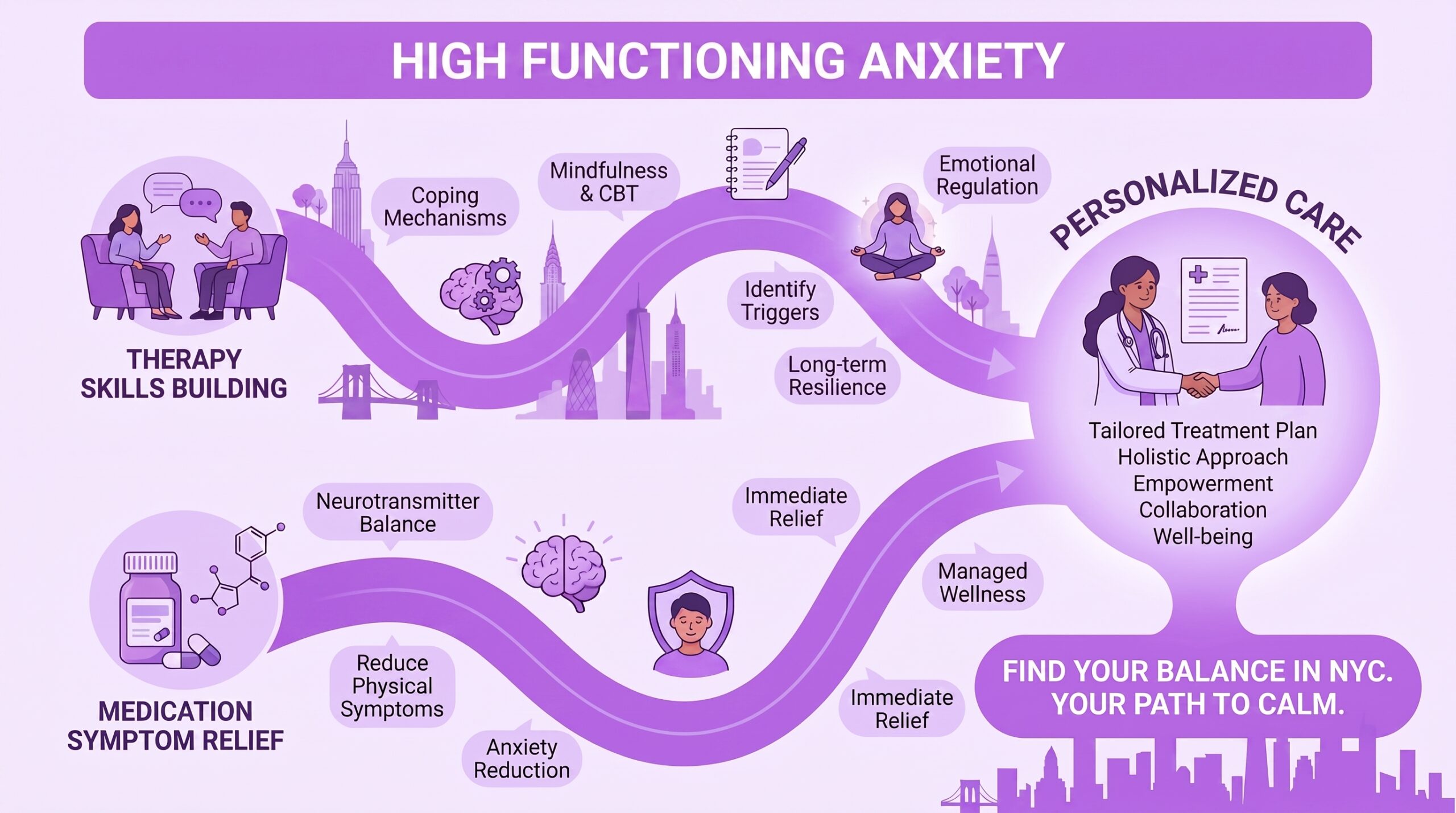
Therapy can be especially effective for high-functioning anxiety because it addresses the patterns that keep anxiety alive, not just the surface symptoms.
For perfectionism, therapy often focuses on the relationship between fear, control, avoidance, and self-worth. The goal is not to lower your standards across the board. The goal is to help you become more flexible, less fear-driven, and more able to choose where your effort actually belongs.
Evidence-based therapy may help you:
- Identify perfectionistic thinking patterns before they take over
- Practice tolerating uncertainty without over-controlling
- Reduce avoidance and procrastination
- Learn how to complete tasks without endless checking
- Separate performance from identity
- Respond differently to criticism, mistakes, and conflict
- Build rest and recovery into your life without guilt
Cognitive behavioral therapy, acceptance-based approaches, DBT-informed skills, and psychodynamic or insight-oriented work can all be useful, depending on the person and the clinical picture. A CBT-oriented clinician, for example, may help you identify the predictions and safety behaviors that maintain anxiety, then practice new responses in a gradual and realistic way.
For many high achievers, therapy also becomes a place to examine the deeper rules they have been living by. Rules like “I must always be useful,” “I cannot disappoint anyone,” or “I am only safe if I am exceptional” may not feel like thoughts at first. They may feel like facts. Therapy helps create enough distance to question them.
Medication for high-functioning anxiety: when it may help
Some people with high-functioning anxiety benefit from therapy alone. Others benefit from medication, either temporarily or longer term. Medication may be worth considering when anxiety is intense, persistent, physically disruptive, or interfering with sleep and functioning.
Medication can sometimes help when:
- Worry feels constant and difficult to interrupt
- Physical anxiety symptoms are frequent
- Panic attacks are occurring
- Sleep has significantly worsened
- Anxiety and depression are both present
- Therapy skills make sense intellectually, but anxiety feels too loud to use them
A common fear among high-functioning patients is that medication will make them less sharp, less motivated, or less like themselves. A thoughtful psychiatric approach should take that concern seriously. The goal is not to dull your personality. The goal is to reduce symptoms that consume energy, narrow your choices, and prevent recovery.
Medication decisions should always be individualized. Benefits, side effects, medical history, prior treatment response, substance use, sleep, and personal preferences all matter. The NICE guideline for generalized anxiety disorder and panic disorder supports individualized, stepped care that may include psychological treatment, medication, or both depending on severity and need.
Therapy vs medication for anxiety: how to choose
For high-functioning anxiety and perfectionism, the decision is rarely about which option is “better.” It is about what kind of support you need first.
Therapy may be a strong first step if your main concerns are perfectionism, overthinking, avoidance, people-pleasing, fear of failure, or difficulty setting boundaries. Medication may be especially helpful if anxiety is so intense that it is affecting sleep, appetite, panic symptoms, physical functioning, or your ability to engage in therapy.
Many people do best with combined care. Medication can lower the volume of anxiety enough for therapy to work more effectively. Therapy can then address the perfectionistic habits and beliefs that medication alone may not change.
| If this is your main challenge | A helpful starting point may be |
|---|---|
| You overthink, over-prepare, and struggle to tolerate mistakes | Therapy focused on anxiety and perfectionism |
| You are having panic symptoms or intense physical anxiety | Psychiatric evaluation, often with therapy support |
| You cannot sleep because your mind keeps racing | Evaluation of anxiety, sleep, and mood together |
| You function well externally but feel close to burnout | Therapy, lifestyle assessment, and possible medication consultation |
| You suspect ADHD, executive dysfunction, or cognitive issues | Comprehensive evaluation, with testing when appropriate |
There is no moral value attached to either choice. Needing medication does not mean you are “worse.” Starting with therapy does not mean you must struggle without symptom relief. The best plan is the one that fits your symptoms, goals, schedule, and values.
Practical strategies that can help with perfectionistic anxiety
Treatment is often the most effective path, but there are also practical shifts that can begin loosening the anxiety-perfectionism loop. These strategies are not a substitute for care when symptoms are severe, but they can help you notice the pattern and begin responding differently.
Practice “clear enough” instead of perfect
Perfectionism often disguises itself as quality control. Before beginning a task, define what “done” means. Not excellent. Not flawless. Done.
For example, instead of “make the best possible presentation,” try “create a clear 10-slide presentation that answers the client’s three main questions.” This gives your brain a finish line.
Set time limits for checking
Checking can feel responsible, but repeated checking often increases doubt. If you reread an email ten times, your brain may learn that emails are dangerous unless checked ten times.
Try setting a reasonable review limit. For low-stakes communication, that may mean one or two checks. For higher-stakes work, it may mean a defined review window rather than open-ended revising.
Notice reassurance loops
Asking for reassurance is human. The problem comes when reassurance becomes the only way to feel safe. If you repeatedly ask others whether something is okay, anxiety may calm briefly, then return stronger.
Instead of immediately seeking reassurance, pause and ask, “What do I already know?” or “What level of uncertainty can I tolerate here?”
Make rest specific
Anxious perfectionists often struggle with vague rest. “Relax more” can feel impossible. A specific recovery plan works better.
Examples include a 20-minute walk without work calls, dinner without email, a phone-free bedtime routine, or one evening per week with no productivity goals. Rest is not a reward for finishing everything. It is part of maintaining your capacity.
Watch for all-or-nothing thinking
Perfectionism often speaks in extremes: success or failure, impressive or embarrassing, productive or lazy. Therapy can help you build a more accurate middle.
A missed detail may be inconvenient, not catastrophic. A difficult conversation may be uncomfortable, not dangerous. A good-enough effort may be appropriate rather than careless.
What to expect from a thoughtful evaluation
A strong evaluation for high-functioning anxiety and perfectionism should feel collaborative, not judgmental. The goal is to understand the whole pattern, including what anxiety is protecting you from, what it is costing you, and what kind of support would be most useful.
A clinician may ask about:
- Anxiety symptoms, panic symptoms, and physical tension
- Sleep, appetite, energy, and concentration
- Work or school demands
- Perfectionism, avoidance, checking, and reassurance-seeking
- Mood symptoms, including depression or irritability
- Trauma history, family expectations, and relationship patterns
- ADHD or executive functioning concerns
- Prior therapy or medication experiences
- Medical history and substance use
Online questionnaires can be a starting point, but they cannot replace a clinical understanding of context. If you are deciding how to assess what is really going on, this comparison of psychiatric evaluation vs online mental health questionnaires may help.
Frequently Asked Questions
Is high-functioning anxiety a real diagnosis? High-functioning anxiety is not a formal psychiatric diagnosis, but it describes a common clinical pattern. Many people function well externally while experiencing significant internal anxiety, overthinking, physical tension, and difficulty resting.
How are perfectionism and anxiety connected? Perfectionism can become a strategy for managing anxiety. If mistakes, criticism, or uncertainty feel threatening, the mind may try to reduce fear through over-preparing, checking, controlling, or avoiding. These behaviors can lower anxiety briefly but keep the cycle going.
How can I tell the difference between healthy ambition and anxiety-driven perfectionism? Healthy ambition is usually connected to values, growth, or meaningful goals. Anxiety-driven perfectionism is more often connected to fear, shame, self-criticism, or the belief that mistakes are unacceptable.
Can therapy help if I do not want to lower my standards? Yes. Good therapy does not require you to stop caring about excellence. It helps you build flexibility, reduce fear-driven behaviors, and separate your worth from flawless performance.
When should I consider medication for high-functioning anxiety? Medication may be worth discussing if anxiety is persistent, physically intense, disrupting sleep, contributing to panic, overlapping with depression, or making it difficult to use therapy skills. A psychiatrist can help you weigh benefits and risks based on your specific situation.
Can high-functioning anxiety be confused with ADHD or burnout? Yes. Anxiety, ADHD, and burnout can all affect concentration, motivation, sleep, and emotional regulation. A comprehensive evaluation can help clarify what is driving the symptoms and what treatment approach is most appropriate.
Getting help in Midtown Manhattan or online
If you are dealing with high-functioning anxiety and perfectionism, you do not have to wait until your life falls apart to get support. In fact, many people seek care precisely because they are still functioning and want to prevent further burnout.
Comprehensive Psychiatric Services in NYC, Dr. Iospa Psychiatry Consulting, offers personalized psychiatric and psychological care in Midtown Manhattan and via telehealth. Care may include psychotherapy, medication management, and, when appropriate, neuropsychological evaluation.
A consultation can help you clarify whether your symptoms are best understood as anxiety, perfectionism, panic, depression, ADHD, burnout, or a combination. From there, treatment can be tailored to your goals and your life, rather than forcing you into a one-size-fits-all plan.
If you would like to explore next steps, you can learn more about the practice and request an appointment at Dr. Iospa Psychiatry Consulting.
Educational disclaimer: This article is for general education and is not medical advice. If you think you may be in danger of harming yourself or someone else, call 911, go to the nearest emergency room, or call/text 988 in the U.S. for the Suicide & Crisis Lifeline.