
Clinically reviewed by Dr. Dana Haywood, PhD, Neuropsychologist
At some point, a lot of students stop saying “I’m stressed” and start saying something quieter, and harder: “I don’t think I can do this like everyone else.” Maybe it happens on a Sunday night in a dorm room, or at a library table in Midtown Manhattan between a shift and a seminar. You stare at the same paragraph until the words blur, then you feel the dread rise because you know you are capable, and you also know you are stuck. When students finally ask about ADHD documentation for college accommodations, they are often not chasing an advantage. They are trying to stop drowning
If you are reading this because a disability services office asked for “documentation that clearly supports ADHD and outlines the functional impact,” you are not alone. The request can feel cold, even when it is standard. You live the symptoms. You have the late nights, the missed details, the panic, the shame. Now you have to translate all of that into paperwork that a university can act on.
This article walks you through what strong ADHD documentation for college accommodations actually looks like, why schools ask for it, and how to avoid the delays that derail students every semester.
Why college accommodations paperwork can feel so personal
Requesting college accommodations is administrative on paper, but emotional in real life. Many students have spent years hearing some version of:
- “You’re smart, you’ll figure it out.”
- “You just need discipline.”
- “Everyone procrastinates.”
So when a disability office asks you to document ADHD, it can trigger a reflexive fear of not being believed.
Here is the reality most students do not hear: disability services offices usually do not judge your character. They have to follow federal disability law and campus policy, and they rely on documentation to connect a diagnosis to specific, reasonable supports.
If you live in New York City, the pressure can turn the volume up. Competitive programs, packed schedules, long commutes, internships that start before your brain fully wakes up, roommates, noise, and constant deadlines can all expose ADHD symptoms that stayed hidden in high school.
College accommodations for ADHD: what documentation is supposed to do
Strong documentation does three things clearly.
It confirms the diagnosis
A disability office typically needs a qualified clinician to state that ADHD is present and describe how they reached that conclusion.
It shows functional impact
“Functional impact” means how symptoms interfere with academic tasks, not whether you are trying hard.
It ties the impact to the requested college accommodations
Schools do best when a clinician explains not only what you need, but why it helps.
If you remember one line, make it this: a diagnosis opens the door, but functional impact gets you through it.

3 steps to stronger ADHD documentation for college accommodations
When midterms or finals are close, students often want a quick fix. The fastest path is usually not rushing, but getting the right pieces in place the first time.
Bring records to your intake, even if they feel “messy.”
If you have prior records, bring them. A timeline helps. Even older documents can support a consistent history.
Helpful records may include:
- Prior psychoeducational or neuropsychological testing
- IEP or 504 plans
- Past accommodation letters (SAT/ACT or school-based)
- Transcripts or report cards that show patterns
- Notes from tutoring, coaching, or therapy
Students often worry that outdated paperwork “doesn’t count.” Even when a school wants more recent documentation, older records can still strengthen the clinical narrative.
Ask your disability office about timelines and interim options
Many students assume college accommodations work like a form you submit and get approved in a week. That is rarely true.
Ask directly:
- How long does a review usually take?
- Do you offer interim accommodations?
- Do you require a specific clinician template?
- Are there exam deadlines for this semester?
Clear timelines prevent the classic NYC scenario: everything is urgent, everyone is booked, and the semester does not pause.
Describe symptoms in functional terms
This is where students unintentionally undersell themselves.
“I get overwhelmed” is real, but vague.
“My working memory drops under time pressure, I lose the steps in multi-part questions, and I leave sections blank even when I know the content” is the kind of statement schools can map to specific support.
If you are unsure how to explain your own impact, track 1 to 2 weeks of concrete examples:
- Missed quiz instructions
- Late submissions despite starting early
- Unfinished exam sections
- Time lost re-reading
- Note-taking gaps (you write, but you miss what is being said)
That short record often helps a clinician write documentation that sounds like you rather than a template.
College accommodations: what disability services usually need in ADHD documentation
Requirements vary by school, so always check your university’s disability services website. Many colleges align with best-practice principles supported by groups like the Association on Higher Education and Disability (AHEAD).
Below are the elements that tend to make documentation clear, credible, and usable.
A clear ADHD diagnosis and clinical reasoning
A strong letter or report does not simply list symptoms. It explains the basis for diagnosis and considers common overlaps.
ADHD can look like, or travel with:
- Anxiety and panic
- Depression and burnout
- Trauma-related symptoms
- Sleep deprivation
- Substance effects
- Learning disorders
- Concussion history
Because ADHD, depression, sleep deprivation, and academic exhaustion can overlap, it may also help to review how college student burnout can affect motivation and academic performance. That overlap matters because a disability office needs to understand what is driving the impairment. If you are trying to sort out whether your focus issues fit ADHD or anxiety, this article may help: ADHD or Anxiety? How Testing Helps Clarify the Difference.
For diagnostic standards, clinicians commonly reference criteria in the DSM-5-TR (published by the American Psychiatric Association) and evidence-based assessment approaches. If you want a high-authority overview of ADHD basics, the National Institute of Mental Health ADHD page is a solid resource.
Functional impact in an academic setting
This section should read like a snapshot of your day-to-day school life.
Examples that often resonate with disability reviewers include:
- Misreading multi-part prompts and losing points despite knowing the material
- Running out of time on exams due to attention lapses and slow retrieval under pressure
- Starting assignments late because task initiation and sequencing break down
- Spending hours reconstructing lectures because note-taking and listening compete
A clinician does not need dramatic language. Specificity builds trust.
Current, individualized information
Schools vary on how “recent” documentation must be. The reasoning is practical: they want to know how you are currently functioning.
“If your last evaluation was years ago or was just a quick screening, a more comprehensive assessment can clarify the picture and strengthen your ADHD documentation for college accommodations considerably.
For a broader explanation of why careful clinician-led evaluation differs from online questionnaires, see: Psychiatric Evaluation vs Online Mental Health Questionnaires.
Recommendations tied to the “why.”
Disability offices respond best to recommendations that match the impairment.
A few examples:
- Extended time makes more sense when documentation explains processing speed, sustained attention breakdown under time pressure, or slowed retrieval when distracted.
- Reduced-distraction testing fits when environmental noise or visual movement reliably pulls attention away.
- Note-taking support works when the student cannot listen and capture key points simultaneously.
The goal is not to request the biggest list. The goal is to request the right support, with a clear rationale.
College accommodations documentation options: letter vs testing
Students often ask what “counts” for college accommodations. The most accurate answer is: it depends on your school, and on how complex your clinical picture is.
Here is a practical overview.
| Documentation type | What it can clarify | When it may help with college accommodations | Notes |
|---|---|---|---|
| Clinician letter (psychiatric or psychological) | Diagnosis, symptom pattern, treatment history, functional impact | Clear ADHD history with consistent academic impact | Must be individualized and connect symptoms to specific supports |
| Psychoeducational evaluation | Academic skills, learning profile, ADHD indicators, and learning disorders | When documentation needs to focus on school performance and learning differences | Often used for academic accommodations and LD evaluation |
| Neuropsychological evaluation | Broader cognitive profile (attention, memory, executive function, processing speed) plus emotional factors | When the picture is complex or a differential diagnosis matters | Helpful when ADHD overlaps with mood symptoms or cognitive concerns |
If you are weighing the difference between psychoeducational and neuropsychological assessment, this guide breaks it down: Neuropsychological vs Psychoeducational Testing: What’s the Difference & Which Do You Need?.
For students exploring evaluation options locally, you can also read: Private ADHD Testing in NYC.
What college accommodations can and cannot do
Most college accommodations aim to provide equal access, not to change what a course fundamentally requires.
That distinction can feel disappointing when you are exhausted. But it also points you toward what works: supports that remove avoidable barriers so your effort finally translates into performance.
Common categories include testing adjustments, reduced-distraction environments, note-taking support, assistive technology, and some flexibility in format, depending on the program.
For the legal backdrop, you can review federal guidance on ADA.gov and from the U.S. Department of Education’s Office for Civil Rights.
NYC timing: avoiding the “everything is due tomorrow” trap
In NYC, students often reach out after something breaks: a failed exam, an academic warning, a sleepless spiral at 2 a.m. in a dorm, or a studio apartment where the radiator clangs all night.
But documentation takes time. Testing takes time. Reports take time. Disability offices take time.
A better mindset is to plan like you would for a competitive application cycle. Not because you have to prove your worth, but because systems move slowly.
A realistic planning rhythm
Aim to start early enough that your support can actually help this semester.
- Check the documentation requirements as soon as symptoms begin to affect performance.
- If you are transferring or starting grad school, review requirements during application season.
- Try to have documentation ready before classes begin, or very early in the semester.
Late summer and early fall can become a bottleneck in New York, especially for busy professionals and students trying to schedule evaluations around internships and travel.
Common documentation mistakes that delay college accommodations
These issues show up every semester, even for very high-performing students.
Vague letters that do not connect ADHD to school impact
“Student has ADHD and needs extended time” reads like a request, not an explanation.
A stronger letter connects symptoms to functional limitations and explains why each accommodation helps.
Outdated or incomplete evaluations
Older testing can still matter clinically, but some colleges ask for an updated evaluation. If you only completed a brief screening, you may need a fuller assessment.
The “anxiety mask” problem
Many students walk in convinced they only have anxiety because anxiety feels loud.
They say:
- “I’m not hyperactive.”
- “I can focus for hours, but only the night before it’s due.”
Sometimes anxiety runs the engine, and ADHD sits in the back seat. Sometimes ADHD creates chaos, and anxiety shows up as the coping strategy. For many students, these struggles become much more noticeable after starting college. Learn more about anxiety and depression in college.
If panic symptoms also show up, this may be a useful read: Anxiety and Panic Attacks: Recognizing the Signs and Getting Help.
Asking for the “biggest” accommodation instead of the right one
Students sometimes request support based on what they saw on TikTok or heard from friends.
Better question: “Which accommodation matches the barrier that costs me the most points, time, or sleep?”
If ADHD documentation brings up shame, that reaction makes sense
I have met many students who carry a private belief that needing help means they are not smart. That belief tends to harden in competitive environments.
But college accommodations do not change your intelligence. They change the conditions under which you have to prove it.
If you have ever walked past construction scaffolding in Midtown Manhattan, you already understand the metaphor. Scaffolding does not build the building. It prevents injuries and makes work at height possible.
That is what the right accommodations can do: they reduce unnecessary penalties so you can show what you actually know.
What a thorough NYC evaluation can look like, and why it helps
When students need college accommodations that hold up under review, it often helps to work with a team that understands both the emotional reality of ADHD and the practical documentation standards universities use.
Dr. Iospa Psychiatry Consulting offers psychiatric care and testing services in Midtown Manhattan and via telehealth in New York. Depending on your needs, you may benefit from a focused ADHD assessment, psychoeducational testing, or neuropsychological testing.
If you want a step-by-step preview of the neuropsychological process, this guide explains what to expect: Neuropsychological Testing Explained: What It Is, Who It Helps, and What to Expect.
Where a YouTube video could be embedded
Right after this section, consider embedding a short YouTube video titled something like: “ADHD College Accommodations: What Documentation Needs to Say.” A 2- to 4-minute walkthrough from a clinician can reduce anxiety and increase follow-through.
Visuals that help students and families quickly understand the process
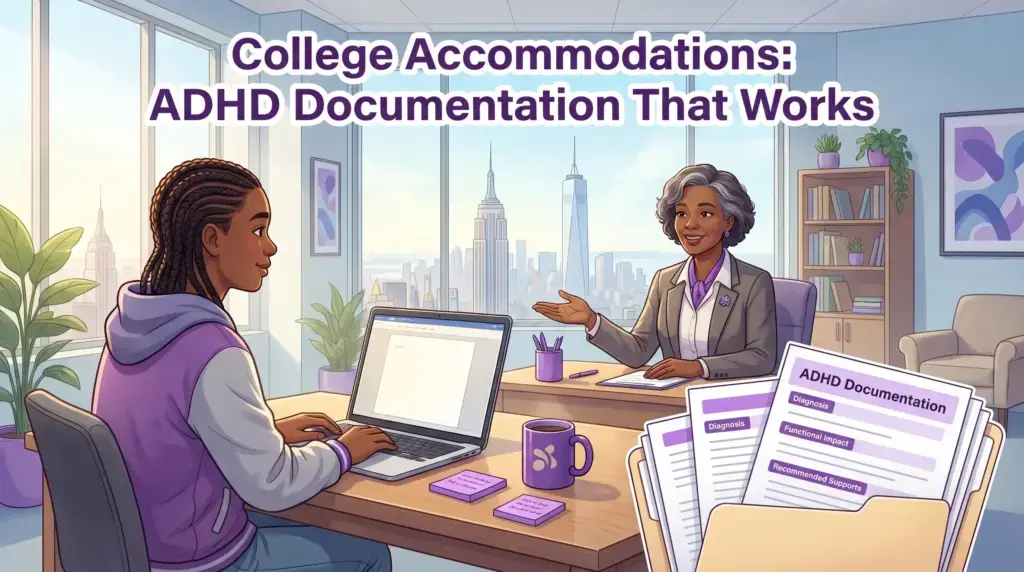
College accommodations often begin with a meeting and documentation that clearly explains academic impact.
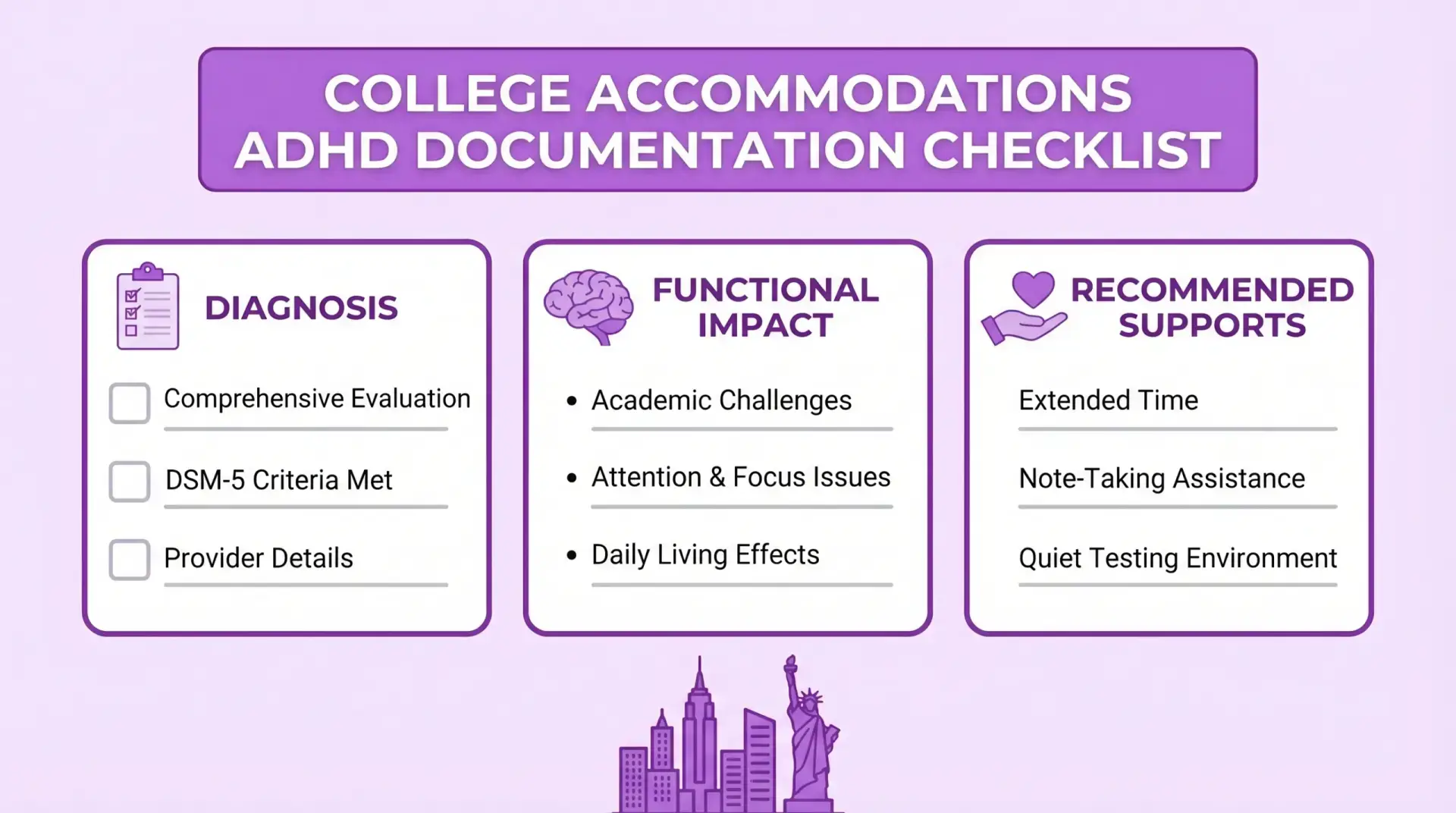
The strongest ADHD documentation connects diagnosis, functional impact, and specific requests.
Frequently Asked Questions
What is the most important part of ADHD documentation for college accommodations? The most important part is functional impact: which academic tasks ADHD makes difficult, how it shows up, and why the requested accommodations address those barriers.
Do I need neuropsychological testing to get college accommodations for ADHD? Not always. Some students are approved with a detailed letter from a clinician. Testing helps when your history is complex, when your school requests it, or when symptoms overlap with anxiety, depression, learning disorders, or concussion history.
My grades are good, but I’m falling apart. Can I still qualify for college accommodations? Possibly. Many disability offices focus on functional limitation, not GPA. A student can earn high grades while paying a steep price in time, sleep, and mental health.
How early should I start the documentation process? Start as early as you can, ideally before the semester begins or in the first few weeks. If you want college accommodations in place for midterms or finals, you need time to evaluate, write, and review.
Can medication history help support my request? It can support the broader clinical picture, but documentation usually hinges on the diagnosis and functional impact, as well as a clear rationale for specific accommodations.
Educational disclaimer
This article is for educational purposes only and is not medical advice. If you are experiencing severe depression, thoughts of self-harm, or feel unsafe, seek urgent help immediately by calling 988 in the U.S. or going to the nearest emergency room.
Get ADHD documentation that is clear, credible, and usable
If you are pursuing college accommodations and want documentation that reflects both the clinical reality and what universities require, Dr. Iospa Psychiatry Consulting offers evaluation and testing services in Midtown Manhattan and via telehealth across New York.
You can explore Private ADHD Testing in NYC, learn about psychoeducational testing for ADHD, or start with neuropsychological testing. For a broader entry point, visit Comprehensive Psychiatric Services in NYC to request an appointment.