
Chronic Stress in College and Graduate School
It often starts with a small private bargain: one more late night, one more skipped meal, one more weekend spent catching up. Chronic Stress in College and graduate school differs from the expected pressure of exams or deadlines. It can feel like living with an alarm that never fully turns off, even when the library closes, assignments are uploaded, or the semester ends.
TL;DR
- College and graduate school can create prolonged stress through coursework, deadlines, financial pressure, uncertain career paths, and changing relationships.
- Some stress passes after a deadline. Chronic stress continues when demands keep coming without enough recovery.
- Common signs include poor sleep, fatigue, irritability, anxiety, brain fog, procrastination, headaches, and feeling constantly overwhelmed.
- Chronic stress can contribute to burnout, anxiety, depression, and worsening academic performance.
- When stress interferes with sleep, health, relationships, or academic functioning, professional support may help.
Why College and Graduate School Can Become Chronically Stressful
College stress rarely comes from one source. A student may juggle a chemistry exam, a research meeting, a part-time job, a difficult roommate situation, and a parent asking about future plans, all in the same week. In New York City, many students add subway delays, high rent, competitive internships, and the feeling that everyone else seems to be moving faster.
The National Institute of Mental Health describes stress as the brain and body response to demands, and academic life supplies those demands in steady waves through deadlines, performance expectations, and uncertainty. Heavy coursework, exams, thesis projects, clinical rotations, internships, student debt, work-school conflicts, and career pressure can all keep the nervous system on alert.
Relationships matter too. A difficult advisor, unclear feedback from a supervisor, or the loss of familiar support systems can make school feel emotionally unsafe. For some students, the hardest part is not the workload itself. It is the constant sense that rest must be earned.
Normal Academic Stress vs. Chronic Stress in College and Graduate School
Normal academic stress often has a beginning and an end. You study for finals, sleep badly for a few nights, then recover. Chronic Stress in College and Graduate School lingers. It continues across weeks or months, even when there is no single crisis.
| Normal Academic Stress | Chronic Stress |
|---|---|
| Usually tied to a specific deadline or exam | Continues for weeks or months |
| Improves after the stressful period | Little sense of recovery |
| Motivation generally returns | Motivation may steadily decline |
| Temporary sleep disruption | Persistent sleep problems |
| Functioning remains relatively intact | Academic and daily functioning may deteriorate |
This distinction matters because many high-achieving students dismiss chronic stress as ambition. They tell themselves they are simply busy. Yet being busy still allows moments of relief. Chronic stress makes the body feel busy even in bed.
Signs Chronic Stress May Be Affecting You
Chronic Stress in College and Graduate School often shows up in ordinary moments. You read the same paragraph four times. You open your laptop and stare at the screen. You snap at a friend, then feel guilty because you know they did nothing wrong.
Common signs include:
- Feeling constantly overwhelmed
- Difficulty concentrating
- Brain fog or forgetfulness
- Procrastination or avoidance
- Irritability
- Sleep problems
- Persistent fatigue
- Headaches or muscle tension
- Changes in appetite
- Loss of motivation
- Social withdrawal
These symptoms do not mean a student lacks discipline. They often mean the system that supports learning, sleep, attention, food, movement, and connection has become overloaded.
The Stress-Performance Cycle
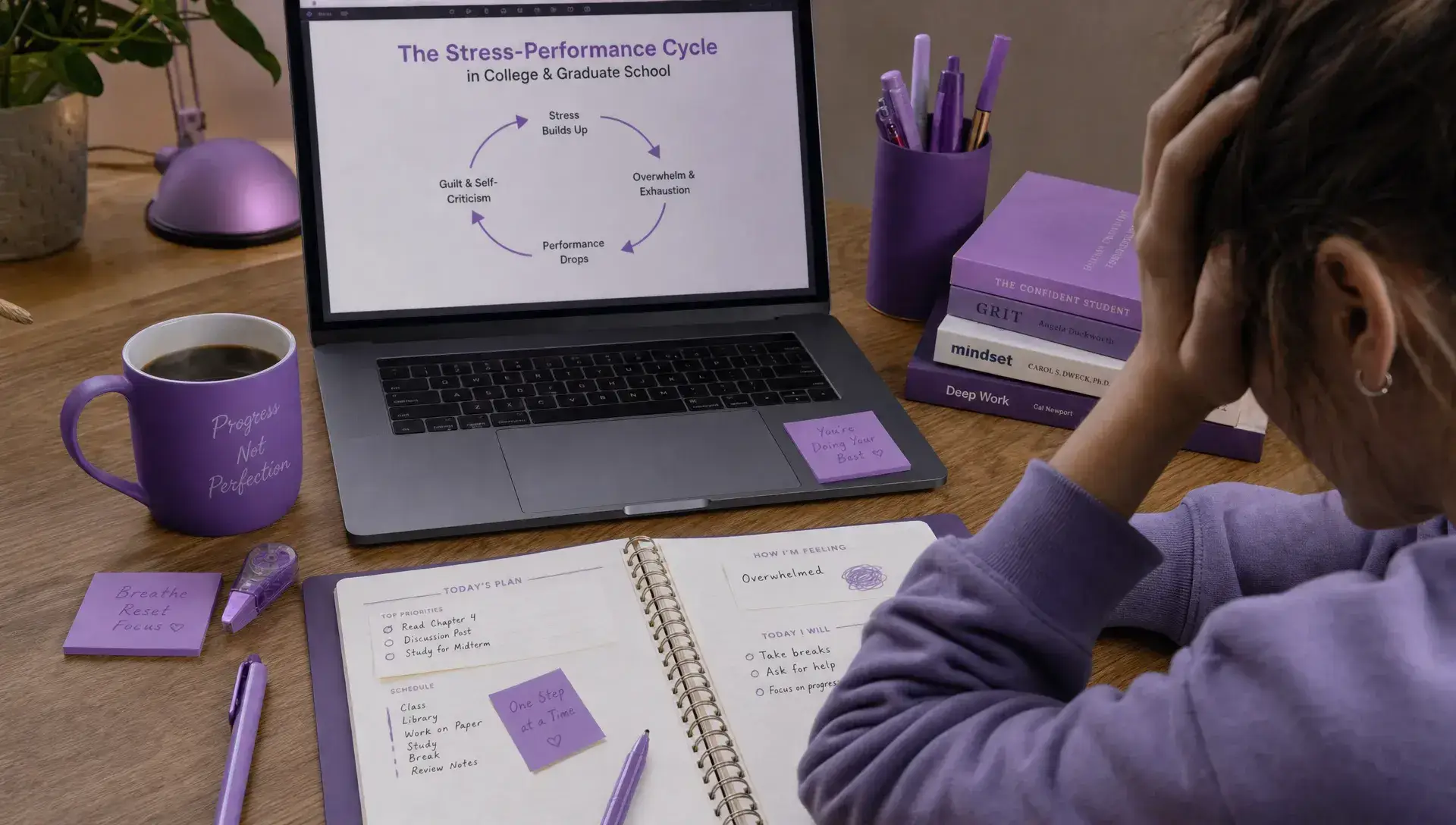
Academic pressure can start a loop that feels hard to break:
Academic Pressure -> Stress -> Poor Sleep and Concentration -> Reduced Productivity -> Falling Behind -> More Stress
A first-year graduate student may begin the semester determined to stay ahead. After several late nights, concentration slips. Reading takes longer. Emails pile up. Shame enters the picture. Instead of resting, the student works later, sleeps less, and becomes less efficient.
This cycle can affect students who usually perform well. In fact, strong students may hide it longer because they can compensate for a while. They submit work, attend meetings, and look functional. Inside, they may feel as if they are holding the semester together with tape.
When Chronic Stress Starts Looking Like Burnout
Burnout is not just fatigue. It often includes emotional exhaustion, loss of motivation, cynicism, detachment, and the painful feeling that nothing you accomplish is enough. A student may finish a major paper and feel no relief. A medical trainee may complete a rotation and feel only numbness.
Burnout and depression can overlap, but they are not interchangeable. Burnout often centers on prolonged stress and depletion. Depression may also bring persistent low mood, loss of interest, hopelessness, appetite changes, or thoughts of self-harm. A careful evaluation helps separate these patterns and identify what kind of support fits.
Can Chronic Stress Lead to Anxiety or Depression?
Chronic stress does not automatically become an anxiety disorder or depression. Still, prolonged pressure can make students more vulnerable, especially when sleep, nutrition, physical activity, and social connection deteriorate simultaneously.
Some students first notice anxiety through panic attacks, racing thoughts, or avoidance. Others notice depression through numbness, isolation, or the sense that effort no longer leads anywhere. For a focused comparison, see the related guide on Chronic Stress vs Anxiety: How Can You Tell the Difference? and the article Can Chronic Stress Cause Depression?.
Students who want a broader college-specific overview may also find this discussion of anxiety and depression in college useful.
Chronic Stress and Sleep in Students
Many students describe the same pattern: exhausted all day, mentally wired at night. The body wants rest, but the mind keeps rehearsing tomorrow, replaying feedback or calculating what has been left undone.
NIH sleep guidance emphasizes that sleep supports learning, mood, and health. When sleep erodes, concentration and emotional regulation often suffer first. For more on the pattern of feeling tired but unable to switch off, read Chronic Stress and Sleep: Why You’re Tired but Can’t Switch Off.
Why Graduate School Can Create Different Stress
Graduate school often creates a quieter, more ambiguous kind of pressure. Coursework may matter, but long-term projects can become the main source of strain. A thesis, dissertation, or research project may have no clear endpoint. Progress can feel invisible for months.
Advisor and supervisor relationships also carry unusual weight. A supportive mentor can help a student grow. A confusing or critical relationship can make every email feel loaded. Publication pressure, teaching responsibilities, financial uncertainty, and post-graduation career concerns add more layers.
Many graduate students also struggle to separate work from personal life. When your research lives on your laptop, your phone, and in your thoughts, leaving the office does not always mean leaving work. The clinic has written more about this pattern in Graduate School Anxiety and Its Impact on Students.
What Can Help With Chronic Stress in College and Graduate School?
The goal is not to eliminate all stress. Academic growth involves effort. The goal is to restore recovery, choice, and perspective.
Start by prioritizing rather than trying to complete everything at once. A stressed brain treats every task as urgent. A written list can help separate what must happen today from what can wait. Large projects also become more manageable when broken into defined tasks, such as choosing sources, drafting one section, or emailing an advisor with one specific question.
Protecting sleep matters more than most students want to admit. So do regular meals, movement, and contact with people who know you outside your performance. Campus academic resources, disability services and counseling centers can help before a crisis develops.
Psychotherapy can help students understand the patterns driving stress, including perfectionism, avoidance, fear of disappointing others, or difficulty setting limits. Some students also benefit from psychiatric care when anxiety, depression, ADHD, or sleep symptoms complicate the picture.
When Should a Student Seek Professional Help?
A student should consider professional support when symptoms persist despite reasonable changes or begin to affect academic performance, sleep, relationships, physical health, mood, or daily functioning. Waiting until everything collapses is not a requirement for care.
ADHD, anxiety, depression, sleep disorders and other conditions can resemble or intensify chronic academic stress. In New York, academic centers such as NYU Langone, where psychiatrist Lenard A. Adler, MD, has contributed widely to adult ADHD care, highlight why attention problems deserve careful evaluation rather than quick assumptions. For cognitive symptoms, work by Columbia Psychiatry psychologist Alice Medalia, PhD, also shows how structured cognitive approaches can support functioning.
At Dr. Iospa Psychiatry Consulting, students can seek psychiatric and psychological care in Midtown Manhattan and online that may include psychotherapy, medication management, neuropsychological testing, or psychoeducational testing when appropriate.
Frequently Asked Questions
Is chronic stress common in college students? Yes. Many students experience prolonged stress during demanding semesters, major transitions, or competitive programs. Common does not mean harmless, especially when stress affects sleep, concentration, or mood.
How do I know if I am stressed or burned out? Stress often comes with urgency and tension. Burnout usually adds emotional exhaustion, detachment, reduced motivation, and difficulty feeling restored even after breaks.
Can chronic stress affect grades and concentration? Yes. Stress can disrupt sleep, attention, memory, and productivity. A student may spend more time working but produce less because the brain has fewer opportunities to recover.
Can academic stress cause anxiety or depression? Academic stress can contribute to anxiety or depression in some students, especially when it persists without support. A professional evaluation can clarify what is happening.
Why am I exhausted even when I am not studying? Chronic stress keeps the mind and body activated. Even downtime may not feel restful if your thoughts keep returning to deadlines, grades, or future worries.
When should I see a therapist or psychiatrist for academic stress? Seek help when stress interferes with sleep, schoolwork, health, relationships, or your ability to function. You do not need to wait for a crisis.
The Bottom Line
Chronic Stress in College and Graduate School should not be dismissed as just part of student life when it leaves you continuously overwhelmed, exhausted, and unable to recover. Recognizing the pattern early can help prevent a worsening cycle of sleep problems, concentration difficulties, mood symptoms, and academic decline.
If you are a student in NYC, a graduate trainee, or a parent worried about a college student, Dr. Iospa Psychiatry Consulting offers a multidisciplinary approach that includes therapy, medication management, and testing when clinically appropriate. Appointments are available in Midtown Manhattan and through telehealth in New York.
Disclaimer: This article is for educational purposes and is not a substitute for diagnosis or individualized medical or mental health advice.