
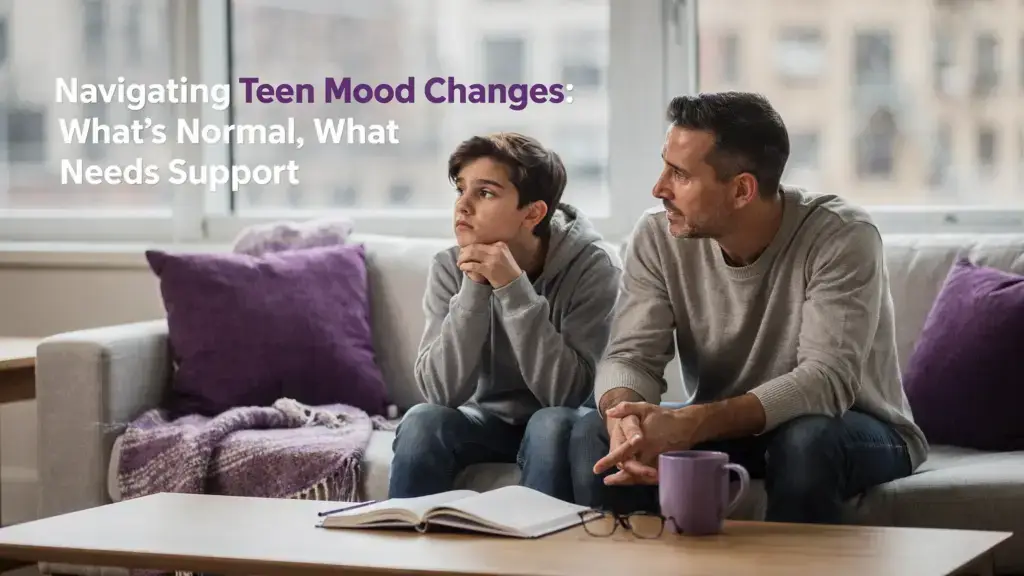
Hormonal changes in adolescence can significantly affect mood, behavior, sleep, and emotional regulation. During puberty, teens experience rapid biological shifts that influence not only physical development but also mental health, sometimes in ways that require thoughtful child psychiatry evaluation and psychological support. Adolescence can feel like a personality change for some families. A teen who was once easygoing may become irritable, tearful, intense, or withdrawn, sometimes within a single afternoon. While “hormones” are often blamed (and they do matter), child psychiatry looks at the full picture: puberty-related hormone shifts interacting with sleep, stress, school demands, social pressure, neurodevelopment, and underlying vulnerabilities like anxiety, depression, or ADHD.
For parents in New York City (and for teens themselves), the goal is not to pathologize normal development. It is to recognize what is typical, what is treatable, and when a professional evaluation can prevent a short-term struggle from becoming a long-term crisis.
What hormonal changes in adolescence actually do, and what they don’t?
Puberty involves significant changes in the endocrine system, including rising levels of estrogen and progesterone in girls and testosterone in boys, as well as shifts in adrenal hormones involved in stress and energy. These hormones influence systems that regulate:
- Sleep and circadian rhythm
- Emotional reactivity and stress sensitivity
- Reward seeking and motivation
- Appetite, energy, and physical restlessness
Hormones can increase emotional intensity, but they rarely explain everything. In clinical practice, “hormones” often become a catch-all that can unintentionally delay care for depression, anxiety, trauma, substance use, eating disorders, or ADHD.
Academic medical centers emphasize that adolescence is a period of profound brain remodeling, including ongoing development of the prefrontal cortex (planning, impulse control) and heightened sensitivity in threat and reward circuits. This is one reason teens can feel emotions more strongly while still building the skills to regulate them. For an overview of teen mental health and when symptoms become a concern, see the National Institute of Mental Health (NIMH).

How Hormonal Changes in Adolescence Affect Teen Mood
From a child psychiatry perspective, puberty-related mood shifts typically come from multiple drivers happening at once.
1) Sleep shifts (and chronic sleep debt)
Teens naturally drift toward later bedtimes due to circadian changes, but early school schedules and heavy workloads can create chronic sleep deprivation. Sleep loss can look like anxiety, depression, ADHD, and oppositional behavior.
If you want a clinician’s perspective on how foundational sleep can be for recovery, our Midtown Manhattan team has a dedicated piece on this topic: Can sleep heal more than we think?
2) Stress biology and “shorter fuses.”
Puberty can amplify stress reactivity. In NYC, stressors can include competitive academics, long commutes, overscheduling, sports and arts commitments, and social media pressure. Stress does not just affect mood; it can also affect concentration, memory, and physical symptoms like headaches or stomachaches.
3) Social recalibration and identity development
Peer dynamics become more emotionally loaded in adolescence. Rejection, exclusion, perfectionism, and identity questions can all intensify. Importantly, teens may mask sadness with irritability, sarcasm, or “I don’t care” behaviors.
4) Underlying neurodevelopmental or psychiatric conditions
Hormonal shifts can expose an existing vulnerability. Common patterns we see clinically include:
- Anxiety that escalates into panic symptoms
- Depression presenting as irritability, apathy, or academic drop
- ADHD is becoming more impairing as executive-function demands rise
If you are seeing worry plus physical symptoms (stomachaches, headaches, school avoidance), you may find this guide helpful: Childhood anxiety red flags every NYC parent should know.
Understanding mood changes in girls during adolescence
Hormones can affect mood in all teens, but many families notice specific patterns in girls, especially after menarche (the first period). Changes in estrogen and progesterone can influence neurotransmitter systems involved in mood regulation. These hormonal changes in adolescence are one reason emotional reactions can feel intense and unpredictable during the teenage years.
What parents often describe:
- Mood symptoms that cluster before a period (irritability, tearfulness, sensitivity)
- More intense conflict at home during certain weeks
- Anxiety spikes, body-image distress, or social withdrawal
- A pattern of “fine at school, falling apart at home.”
It can be helpful to track symptoms for 2 to 3 cycles (sleep, appetite, energy, anxiety, tearfulness, anger, focus, and any self-harm thoughts). A pattern does not automatically mean a disorder, but it gives your clinician higher-quality data.
If your teen’s mood is persistently low, they seem emotionally “flat,” or you see withdrawal and loss of interest, this article may help you differentiate depression from normal stress: Teen depression isn’t always sadness: hidden symptoms to watch for.
When to think beyond “PMS.”
Some adolescents experience severe, impairing mood symptoms linked to the menstrual cycle. A clinician may evaluate for conditions like PMDD (premenstrual dysphoric disorder) or for depression/anxiety that worsens premenstrually. Academic hospitals such as the Mayo Clinic describe PMDD as more intense than typical PMS and associated with significant functional impairment.
What about boys, testosterone, and irritability?
In boys, rising testosterone and rapid physical growth can coincide with more sensation-seeking, competitiveness, or irritability. But persistent anger, aggression, risk-taking, or emotional shutdown can also reflect:
- Anxiety or depression
- ADHD with emotional dysregulation
- Sleep problems
- Substance use
- Trauma exposure
When symptoms are intense or risky, it is worth assessing clinically rather than attributing it solely to puberty.
What’s “normal” vs what signals a need for evaluation?
A practical way to think about this is impairment and duration: Is your teen still functioning overall, and are symptoms improving with support and time, or are they escalating and spreading across settings?
| Pattern | More consistent with typical adolescence | More consistent with needing evaluation |
|---|---|---|
| Duration | Ups and downs that come and go | Low mood, anxiety, or irritability most days for 2+ weeks, or recurring episodes |
| Functioning | Still attending school, engaging with some friends/activities | Grades dropping, frequent absences, quitting activities, social isolation |
| Safety | No self-harm, no suicidal talk, no dangerous behaviors | Self-harm, suicidal thoughts, severe impulsivity, substance misuse, unsafe sexual situations |
| Physical symptoms | Occasional stress headaches or stomachaches | Persistent somatic complaints, sleep reversal, major appetite/weight change |
| Emotional control | Arguments, but repair happens | Rage episodes, prolonged shutdown, or constant conflict that derail home life |
If you are unsure, a consultation can help clarify what is developmentally expected and what is treatable.
What a child psychiatry approach looks like in NYC
A high-quality evaluation typically aims to answer a few key questions:
- What symptoms are present (mood, anxiety, attention, impulsivity, sleep, eating, substance use)?
- When did they start, and what changed around that time?
- Are there medical contributors that should be ruled out by the teen’s pediatrician (for example, anemia, thyroid issues, or other relevant conditions based on history)?
- Is there a learning, attention, or executive-function issue driving stress and conflict?
At Dr. Iospa Psychiatry Consulting in Midtown Manhattan and via telehealth in New York, care can include therapy approaches (CBT, DBT skills, supportive therapy), medication management when appropriate, and coordinated psychological testing when attention, learning, or cognitive concerns are part of the picture.
Related reading that many families find useful:
- Teen anxiety or depression? Subtle signs NYC parents often miss (and what helps)
- Understanding anxiety and panic attacks: recognizing the signs and getting help
When neuropsychological or psychoeducational testing helps (especially for school)
Sometimes “mood swings” are downstream from chronic overwhelm: a teen is trying twice as hard as peers, still falling behind, then melting down at home. In those cases, testing can be a turning point because it converts confusion into a plan.
Testing can help:
- Clarify ADHD vs anxiety vs learning disorder vs a combination
- Document needed school supports (504/IEP) or college accommodations
- Identify executive-function weaknesses (planning, initiation, working memory)
If you are considering an evaluation, these guides explain options clearly:
- Neuropsychological vs psychoeducational testing: what’s the difference and which do you need?
- Could ADHD or a learning disability be holding you back? How psychoeducational testing can help
For families seeking a private, confidential route in NYC, you can also read about private ADHD testing in NYC.
Treatment options that match real teen life
Effective care usually blends skills, environment, and (when appropriate) medication. NIMH emphasizes that evidence-based treatments exist for adolescent mental health conditions, and early intervention can reduce long-term impairment.
Therapy that targets what puberty amplifies
Depending on the presentation, a teen may benefit from:
- CBT for anxiety, panic, and negative thought loops
- DBT-informed skills for emotion regulation, distress tolerance, and conflict cycles
- Supportive therapy for identity stress, self-esteem, and relationship challenges
Medication management (when appropriate)
Medication can be helpful for conditions like moderate-to-severe depression, certain anxiety disorders, and ADHD, but it should be individualized and monitored. For example, the U.S. Food and Drug Administration (FDA) maintains guidance on antidepressant-related suicidality warnings in youth, which underscores why careful assessment, education, follow-up, and safety planning matter.
Cognitive remediation and skills building
If attention, processing speed, or cognitive flexibility is contributing to emotional overwhelm, skills-based cognitive interventions can complement therapy. Our practice has educational resources on cognition-focused care, including a video series announcement here: Cognitive Remediation Therapy (CRT) video series on YouTube.
A note on appearance-related stress (including dental and orthodontic changes)
Puberty often brings visible changes (in skin, weight distribution, and growth spurts) that can affect self-confidence. For some teens, dental changes and orthodontic treatment can also become part of that identity shift. If your family is navigating orthodontic decisions abroad, resources like digital orthodontics in Bucharest can be an example of how treatment planning and predictable steps may reduce uncertainty, which is a common anxiety driver for teens.
Where Dr. Dana Haywood’s perspective fits in (attention, hormones, and emotional load)
Hormonal transitions can complicate attention and emotional regulation, especially for girls and young women whose ADHD may be overlooked or misattributed to anxiety or “teen drama.” If that sounds familiar, Dr. Dana Haywood’s discussion may resonate: ADHD in women (with Dr. Dana Haywood).
For families who are also worried about cognitive functioning (for example, after concussion, medical illness, or persistent brain fog), our team-oriented approach to testing and baseline tracking is explained here: Worried about memory loss? Why building a cognitive baseline matters.
When to seek urgent help
Seek urgent evaluation (ER or emergency services) if your teen:
- Talks about wanting to die, not wanting to exist, or makes threats of self-harm
- Has engaged in self-harm or a suicide attempt
- Is using substances in a dangerous way, appears intoxicated, or is behaving unpredictably
- Is not sleeping for long periods with escalating agitation, risky behavior, or possible psychosis
Understanding hormonal changes in adolescence helps families respond with empathy while knowing when psychiatric and psychological interventions may be beneficial. If you are a NYC parent looking for guidance on crisis-level red flags, our team also outlines scenarios that warrant immediate action here: Vaping, weed, alcohol, self-harm: when it’s a mental health emergency.
Getting support in Midtown Manhattan (or via telehealth in New York)
If puberty-related changes are colliding with anxiety, depression, panic attacks, academic decline, or suspected ADHD, a child and adolescent psychiatric evaluation can help you sort signal from noise and create a plan that fits your teen’s real life.
You can learn more about the practice and request an appointment at Dr. Iospa Psychiatry Consulting.
Disclaimer: This article is for educational purposes only and is not medical advice. Reading this information does not create a doctor-patient relationship. Decisions about treatment or medication should be made with your own clinician, who can take your personal history into account.