
Medically reviewed by Alla Iospa, MD, Psychiatrist
Monday morning in New York can feel like a stress test. Your alarm rings, your inbox fills, and the subway platform already crowds. If you keep functioning but feel worse each week, one question usually follows: Burnout or Depression?
Many high-achieving New Yorkers ask that question in private, then push through anyway. You deserve a clearer answer. The right next step depends on what drives the crash, and small clues often point you in the right direction.
Burnout or Depression: Why the distinction matters in NYC
NYC rewards output. That culture can hide real suffering in plain sight. People keep showing up to meetings, rehearsals, classes, and childcare drop-offs while feeling numb, brittle, or detached.
Clinically, Burnout or Depression leads to different care plans. You do not need a label to “count” as struggling. You need a plan that fits your symptoms, your context, and your nervous system.
The World Health Organization describes burnout as an occupational phenomenon tied to chronic workplace stress that you do not manage successfully. It includes exhaustion, mental distance or cynicism related to work, and reduced professional efficacy. Read the WHO description here.
Depression is a medical condition. It can affect mood, sleep, appetite, concentration, self-worth, and even how your body experiences fatigue and pain. The National Institute of Mental Health provides an overview here.
Burnout and depression can overlap. Symptoms can also shift over time. A good clinician does not rush the conclusion. They look for patterns, triggers, and functional changes.
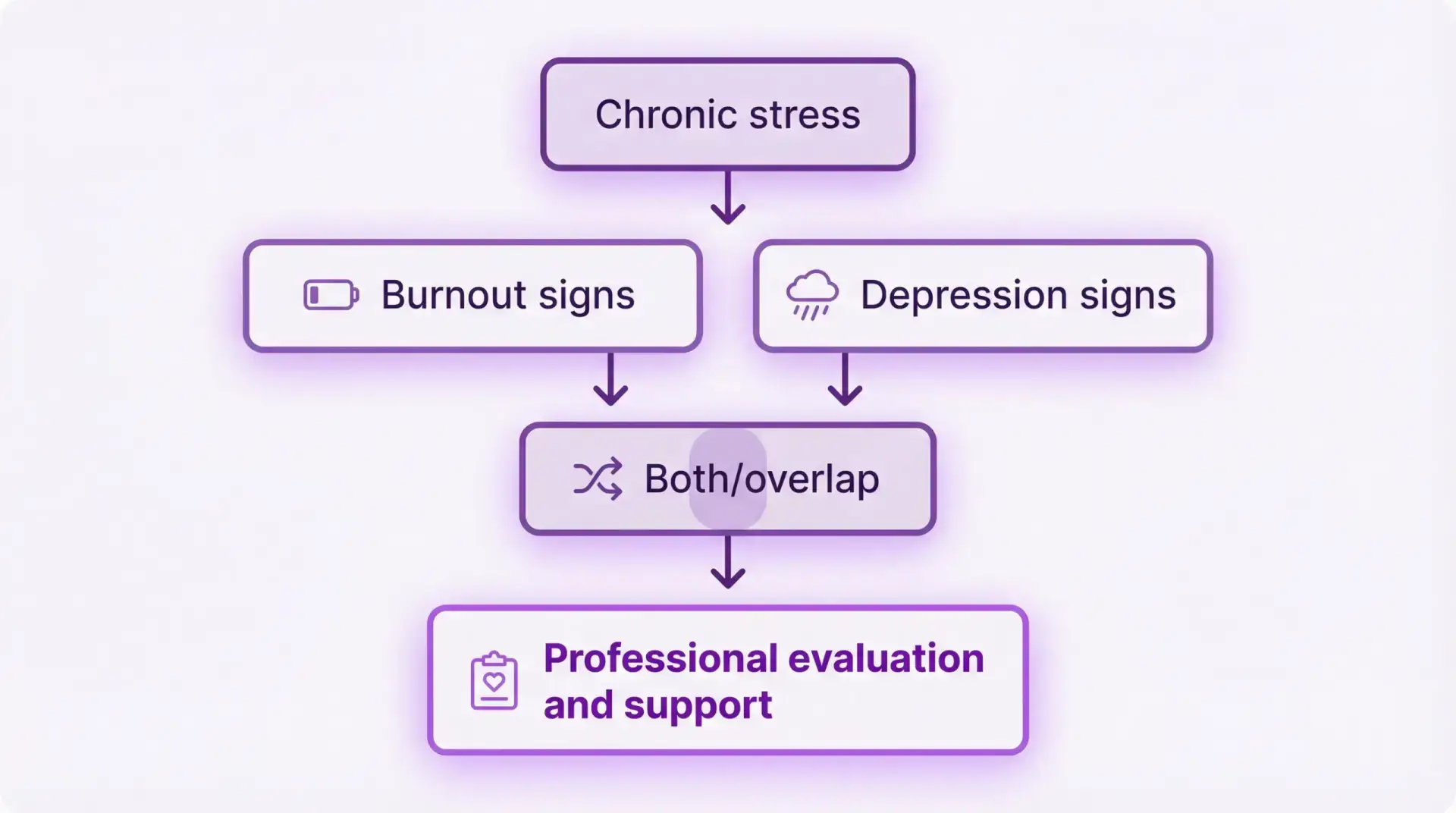
A quick way to organize your symptoms before you seek help.
NYC clinician clues that help you tell burnout from depression
In Midtown, people rarely walk in and announce burnout. They usually describe a set of changes that scare them:
- “I feel dread on Sundays.”
- “I reread the same paragraph five times.”
- “I snap at my partner, then I hate myself for it.”
- “I earned a promotion and felt nothing.”
A clinician listens for a few practical clues. These clues do not replace a diagnosis. They help you decide what to do next.
Burnout or Depression clue #1: Does your distress stay tied to one pressure source?
Burnout often tracks closely with one system, such as a job, a team, a program, or a role that became unsustainable. Many people say, “If I could get out from under this, I would feel like myself again.” For students, that pressure source may be a demanding college environment rather than a workplace. Our guide to college burnout and academic exhaustion looks more closely at how this pattern appears in student life.
Depression can start with work stress, but it usually spreads. You might notice detachment at work and at home. You might stop caring about things that used to matter.
If your distress feels situation-linked, you might also find this guide useful: Why burnout isn’t just stress.
Burnout or Depression clue #2: Does time off actually help?
A long weekend often reveals a lot.
Burnout often shows partial relief when the pressure drops. You might sleep for a day, then feel your humor return or your body loosen.
Depression often ignores the calendar. You can clear the schedule and still feel heavy, flat, or disconnected.
This clue does not measure gratitude. It measures your ability to reset.
Burnout or Depression clue #3: Can you still access joy in small doses?
With burnout, many New Yorkers stop caring about work but still enjoy parts of life. They might feel better during dinner with friends, a run on the Hudson, a Broadway show, or time with their kids.
Depression often blunts pleasure itself. People describe eating a favorite food and tasting nothing. They describe watching a comedy and never smiling. They can walk through the city and feel behind glass.
If your symptoms feel subtle or “not sad enough,” this may help: Depression treatment in Midtown NYC: how to spot the hidden signs.
Burnout or Depression clue #4: Do you feel tired, or do you attack yourself?
Burnout can bring irritability and numbness. Many people still hold one stabilizing belief: “I’m capable, but this setup drains me.”
Depression often turns self-talk into certainty and cruelty:
- “I’m failing at everything.”
- “People would be better off without me.”
- “Nothing will change.”
That kind of absolute thinking deserves support from a professional. You cannot out-hack it with another productivity system.
Burnout or Depression clue #5: What does your body do under pressure?
Burnout often shows up as constant vigilance. Your body braces for impact. You might notice a racing heart, chest tightness, stomach issues, or sudden fear.
If you wonder whether you have panic symptoms, start here: Understanding anxiety and panic attacks.
Depression can also show up in the body. Many people notice changes in sleep and appetite, low energy, aches, or a slowed, heavy feeling.
Burnout or Depression clue #6: What explains your “brain fog” best?
Many patients fear they are “losing it.” They miss words in meetings. They feel slower. Planning feels impossible.
Burnout can impair attention and memory. Depression can do the same. Anxiety, chronic sleep loss, medication effects, and untreated ADHD can also contribute.
A comprehensive evaluation can clarify what drives the cognitive symptoms and what does not. These resources can help you understand the options:
Burnout or Depression: a quick self-check you can use
This self-check does not diagnose you. It helps you organize what you notice so you can ask for the right kind of help.
| What you’re noticing | More typical of burnout | More typical of depression | What helps next |
|---|---|---|---|
| Main trigger | Work or role-specific overload | Can start with work, but spreads across life | Identify drivers, assess mood, and functioning |
| After real rest | Some relief, even partial | Little to no relief | Clinical evaluation, therapy, and sometimes medication |
| Pleasure | Often accessible outside work | Muted or absent | Treat mood, rebuild routine, address isolation |
| Self-talk | “I’m depleted.” | “I’m broken” or “I’m a burden.” | Supportive therapy, CBT/DBT, safety planning when needed |
| Energy | Exhausted, resentful, cynical | Exhausted, slowed down, hopeless | Tailored plan, sleep support, medical rule-outs |
| Focus and memory | Worse under pressure, can improve with recovery | Fog persists, motivation hard to access | Consider evaluation, testing if indicated |
If you want a simple summary: burnout often improves when the system changes, depression often persists even when the schedule does.
What getting help can look like in NYC
Many New Yorkers delay care because scheduling feels like another job. You can keep the first step simple.
A comprehensive psychiatric evaluation provides context for history, sleep, anxiety, mood, attention, and relevant medical factors. Depending on the evaluation, care may include psychotherapy, medication management, and testing.
- Psychotherapy (often practical and skills-based, like CBT, DBT, or supportive therapy)
- Medication management when appropriate
- Neuropsychological or psychoeducational testing when attention, learning, or cognitive concerns feel central
- Cognitive remediation therapy when specific cognitive skills need targeted work
Our practice offers multidisciplinary care in Midtown Manhattan and via telehealth: Comprehensive Psychiatric Services in NYC.
What you can do this week if you feel stuck
If you keep circling Burnout or Depression, run a short experiment. Collect data instead of chasing willpower.
- Name the drain precisely: Try “nonstop context switching,” “loneliness after work,” or “dread before meetings.”
- Protect one recovery window: Pick 30 to 60 minutes at the same time each day. Put your phone on Do Not Disturb. Choose something you can repeat in NYC, like a walk in Bryant Park or the Hudson River Greenway, or quiet time in a library.
- Ask one person for one concrete thing: Say “Can you handle bedtime Tuesday?” or “Can you sit with me while I answer three emails?” Specific requests reduce shame.
- Track sleep as it matters: Waking at 3 a.m. with a racing mind is not a minor detail. This article can help: Can sleep heal more than we think?
When it’s urgent, do not wait
If you think about harming yourself, feel unsafe, or cannot care for yourself or your child, get immediate help.
Call or text 988 in the U.S. (Suicide & Crisis Lifeline), available 24/7: 988 Lifeline
If you face immediate danger, call 911 or go to the nearest emergency room.
Frequently Asked Questions
Burnout or Depression: can I have both? Yes. Many people experience both, especially after long periods of chronic stress. Treatment often addresses workload and recovery while also treating mood symptoms directly.
Burnout or Depression, which one causes brain fog? Both can. Anxiety and poor sleep can also drive brain fog. ADHD and medical issues can contribute too. A psychiatric evaluation and sometimes neuropsychological testing can clarify the causes of cognitive symptoms.
How do I know if I need medication management? Medication can help with depression, anxiety, panic, and sleep disruption, and sometimes ADHD. A clinician should review your symptoms, history, and goals, then discuss risks and benefits.
If I take a vacation and still feel awful, is that depression? Not automatically, but it matters as a clue. If rest does not ease the heaviness, pleasure feels unavailable, or hopelessness shows up, schedule a professional assessment.
I’m functioning at work. Does that mean it’s not depression? No. Many high-achieving New Yorkers continue to perform while feeling numb, despairing, or disconnected. Functioning is not the same as well-being.
Medically reviewed by Dr. Konstantin Nikiforov, MD, General and Geriatric Psychiatrist, Assistant Professor of Psychiatry at the Icahn School of Medicine at Mount Sinai.
Educational disclaimer
This article is for educational purposes only and is not medical advice. If you feel concerned about your mental health, seek an evaluation from a licensed clinician.
If you want clarity, we can help
If you feel stuck on “Burnout or Depression,” you do not need to solve it alone at 2 a.m. Dr. Iospa Psychiatry Consulting provides personalized psychiatric care, psychotherapy, medication management, and neuropsychological testing in Midtown Manhattan and via telehealth.
Schedule a consultation here: Dr. Iospa Psychiatry Consulting