
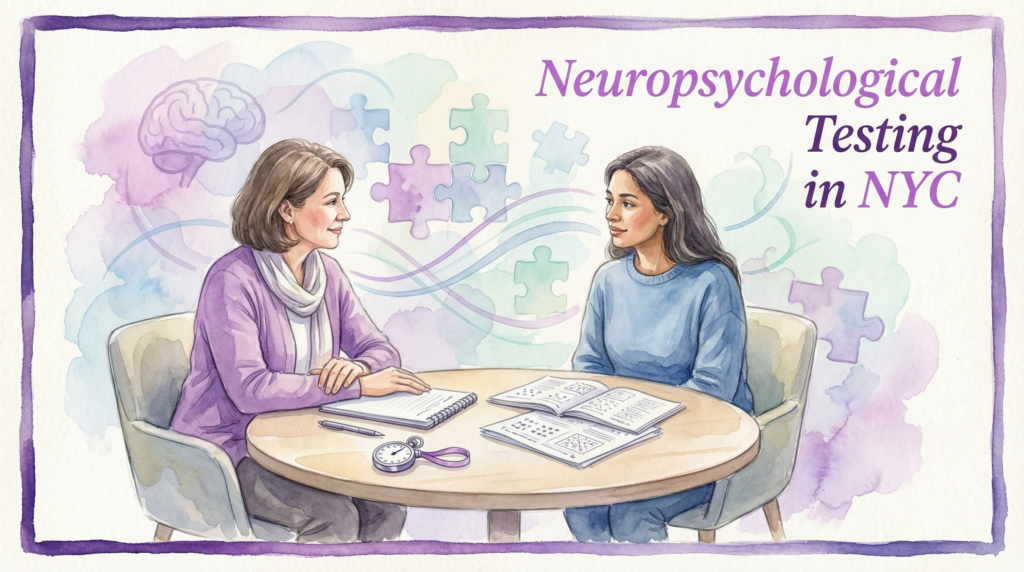
When you are struggling with focus, memory, or mental stamina, it can be hard to tell what is actually happening. Is it ADHD, anxiety, depression, burnout, a learning disorder, perimenopause, Long COVID brain fog, or early cognitive change? Neuropsychological testing is designed to answer that question through structured, evidence-based measurement of how your brain is functioning at present.
If you are considering an evaluation in New York, learn more about our comprehensive neuropsychological testing in NYC, including who may benefit, what testing evaluates, our neuropsychology team, and how to schedule an assessment.
At Dr. Iospa Psychiatry Consulting in Midtown Manhattan (NYC), neuropsychological evaluation is often used to clarify diagnosis, guide treatment, and create actionable documentation for school or workplace accommodations. Patients use neuropsychological testing to obtain clear, objective assessments of attention, memory, and cognitive function.
What neuropsychological testing is and what it is not
A neuropsychological evaluation is a comprehensive assessment that measures cognitive skills, including attention, memory, processing speed, language, executive functioning (planning, organization, impulse control), and, in some cases, motor or visual-spatial skills. Results are interpreted in the context of your history, symptoms, medical factors, and emotional functioning.
Unlike quick “brain games” or online screeners, formal testing uses standardized measures administered and interpreted by a clinical neuropsychologist. The goal is not just a score; it is a pattern that helps explain why you are struggling and what to do next.
If you want a practice-focused overview of the process, start here: What Is Neuropsychological Evaluation?.
Who does neuropsychological testing help most
Neuropsychological testing can be helpful at many life stages. In a busy city like New York, it is especially valuable when high demands make subtle issues feel urgent.
Adults who suspect ADHD
Adult ADHD can look like chronic overwhelm, procrastination, inconsistent performance, time blindness, emotional reactivity, and burnout. For many women, symptoms are missed for years because they are internalized (anxiety, perfectionism, masking) rather than disruptive.
Testing can help differentiate ADHD from common look-alikes like anxiety disorders, major depression, sleep disruption, medication effects, and trauma-related symptoms. For college students and recent graduates navigating this process, our step-by-step guide on how to document ADHD for college accommodations explains what schools require and how evaluation results translate into support. For more on this presentation, see: ADHD in women. (NIMH also provides a clinical overview of ADHD symptoms and diagnosis.)
Parents of children and teens with academic decline or attention problems
When grades decline, families often hear, “They are not trying.” Neuropsychological or psychoeducational testing can uncover underlying attention and executive-function challenges, learning disorders, anxiety, or mood issues.
A useful related read is: Why Your Child May Need a Child and Adolescent Psychiatrist (Academic Decline + Attention & Executive Function).
College students who need documentation for accommodations
If you are seeking extended time, reduced-distraction testing, note-taking support, or other academic accommodations, schools typically require current documentation linking a diagnosed condition to functional impairment.
If academics are the primary concern (reading, writing, math skills, and learning profile), this may be a better fit: “How Psychoeducational Testing Can Help.” If you are unsure which evaluation you need, this comparison can clarify the next steps: Neuropsychological vs Psychoeducational Testing: What’s the Difference & Which Do You Need?.
Adults worried about memory loss or cognitive decline
Many people notice changes in memory or word-finding during periods of high stress, poor sleep, depression, menopause transition, or medical illness. Others want to establish a baseline so future change is easier to detect.
A neuropsychological baseline is especially useful if you are worried about early cognitive change, have a family history of dementia, or want objective data rather than guessing. Learn more here: Why Building a Cognitive Baseline Matters. For authoritative background on memory and aging, the NIH National Institute on Aging explains what is typical vs concerning in its cognitive health resources. Adults navigating retirement who have concerns about memory or cognitive changes are among those who benefit most — see issues related to aging and retirement for the broader context.
People recovering from a concussion, brain injury, or neurological illness
After a concussion or traumatic brain injury (TBI), people may experience slowed processing, attention lapses, irritability, sleep changes, and fatigue that interfere with work and relationships. Neuropsychological testing can help quantify strengths and weaknesses, track recovery, and guide supports.
For medical context on TBI, see the NIH National Institute of Neurological Disorders and Stroke: Traumatic Brain Injury information.
What to expect during a neuropsychological evaluation
While the exact structure varies by referral question, most comprehensive evaluations include the components below.
| Step | What happens | Why it matters |
|---|---|---|
| Intake interview | Detailed history (symptoms, school/work, medical, sleep, mood, medications) | Interprets test results in a real-world context |
| Standardized testing | Paper-and-pencil and/or computerized tasks across cognitive domains | Identifies patterns consistent with ADHD, learning issues, mood effects, neurologic conditions, and more |
| Rating scales | Questionnaires for you (and sometimes a partner/parent/teacher) | Captures day-to-day functioning across settings |
| Feedback + report | Explanation of findings and recommendations, plus written documentation | Turns results into an actionable plan and, when relevant, documentation for accommodations |

A common concern is, “Will I fail?” Neuropsychological testing is not a pass/fail exam. It is a measurement process designed to show how you think and how tasks break down under specific conditions (e.g., speed, distraction, working memory load). Many test batteries also include performance-validity measures to ensure results are interpretable and not unduly influenced by factors such as misunderstanding instructions, severe fatigue, or inconsistent effort.
What you get after testing and how it can change treatment
A strong evaluation does not end with scores. It connects results to decisions.
Clearer diagnosis and differential diagnosis
Testing can help distinguish between conditions that feel similar day to day, such as:
- ADHD vs anxiety-driven distractibility
- Depression-related slowed processing vs a primary attention disorder
- Sleep deprivation and burnout vs a neurocognitive disorder
- Learning disorder vs inadequate study strategies
That clarity matters because treatment differs. For example, the evidence-based care plan for ADHD may involve skills-based therapy and coaching, and may include medication management when clinically appropriate (FDA information on approved stimulant and non-stimulant ADHD medications is available via the FDA’s medication resources).
Targeted recommendations you can actually use
Depending on the findings, recommendations may include psychotherapy (e.g., CBT or DBT skills), medication management, executive function strategies, academic accommodations, workplace modifications, and cognitive rehabilitation.
If attention, processing speed, or working memory are key issues, cognitive-focused treatment may help. Dr. Iospa’s team discusses options such as CBT and Cognitive Remediation Therapy in CBT vs. CRT.
Documentation for schools and testing accommodations
For students, a high-quality report typically links diagnosed conditions to functional limitations and provides specific recommendations that schools can implement (for example, extended time or reduced-distraction settings). Requirements vary by institution, so it is smart to check your program’s documentation guidelines before scheduling. Once you have your report, the next step is understanding how to act on it. For a practical guide to what the post-testing phase looks like — from reading your results to building a prioritized treatment plan — see What Happens After Neuropsychological Testing.
Who provides neuropsychological testing at Dr. Iospa Psychiatry Consulting
Neuropsychological testing should be performed and interpreted by appropriately trained clinicians. At Dr. Iospa Psychiatry Consulting, care is designed to be collaborative across psychiatry, therapy, and assessment.
To learn more about working with Dr. Dana Haywood, PhD, visit her profile page
For a short video related to attention and lived experience (especially in women), you can also watch: ADHD in Women (video).
If you are interested in the practice’s cognitive skills work and ongoing video education, this announcement page also links to their 3-part Cognitive Remediation series on YouTube.
How to prepare so your results reflect your real functioning
Good preparation helps ensure the data is valid and useful.
- Sleep as normally as you can the night before. A severely shortened night can reduce attention and memory in ways that are hard to interpret.
- Bring what you use to function well, such as glasses, hearing aids, or a list of current medications.
- Expect mental fatigue. Testing is effortful by design. Plan a lighter schedule afterward if possible.
- Share prior records, if available (past evaluations, IEP/504 plans, and relevant medical records). Historical context improves diagnostic accuracy.
If you are a self-pay patient seeking a faster, private pathway to answers, it can help to ask in advance about scheduling, documentation timelines, and any insurance claim support options.
When to consider neuropsychological testing in NYC and when not to.
Consider an evaluation when cognitive symptoms persist, affect performance, or create high-stakes consequences (school failure, job risk, safety concerns). It is also reasonable to try “common sense fixes” (sleep, planners, therapy, reduced workload) when you still feel stuck.
Testing is usually not the first step when concentration dips briefly during an acute life stressor. In those cases, a psychiatric evaluation and treatment for anxiety, depression, insomnia, or burnout may be the most efficient starting point. (If you are trying to distinguish stress brain fog from true decline, this guide may help you decide what is next: Brain Fog vs Cognitive Decline.)
Next step: schedule the right evaluation for your goals
Neuropsychological testing is most valuable when it answers a specific question and leads to a usable plan, not just a label. If you are in NYC, seeking an evaluation in Midtown Manhattan, or prefer a telehealth consultation, you can explore services and request a consultation through Dr. Iospa Psychiatry Consulting.
If you are in crisis or worried about immediate safety, call 911 or go to the nearest emergency room.
Clinically Reviewed by Neuropsychologist Dana Haywood, PhD